Digital Piano Manufacturing: The Surprising Truth About How Pianos Are Made Today
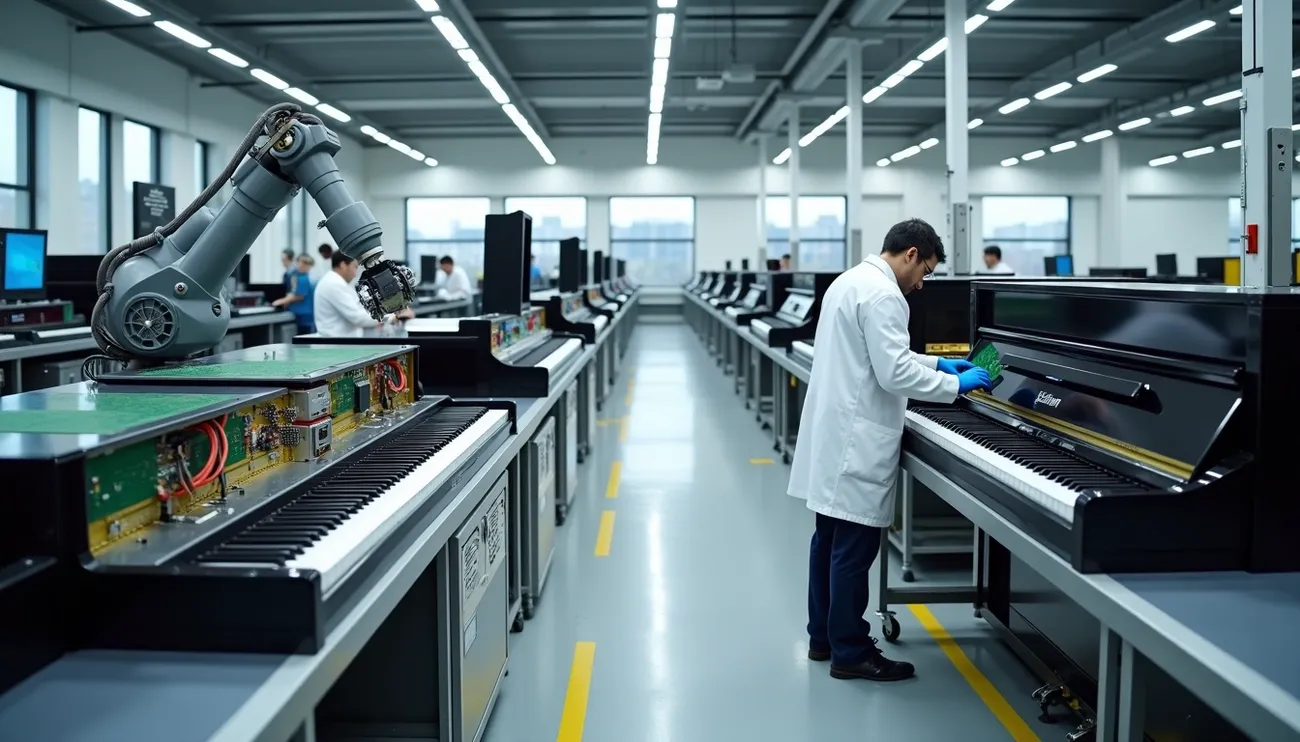
Digital piano factories today operate very differently than they did 30 years ago. The shift from acoustic to digital piano production happened because families wanted instruments that cost less, need no tuning, and fit in smaller Dubai apartments [1]. Electronics changed how pianos work – instead of wooden hammers hitting strings, you now press keys that trigger digital sounds through speakers [1]. Most digital pianos cost between 2,000 and 15,000 AED, making them much more accessible than acoustic pianos that start around 20,000 AED [1]. Modern factories focus on building instruments for music students and home practice, with features like headphone jacks and built-in lessons [1]. These factories use computer-controlled machines to build weighted keys, circuit boards, and speaker systems. You’ll find digital pianos made in Japan, China, and occasionally the USA – each with different quality standards and price points. Here’s exactly how these instruments come together in modern piano factories, and what this means for your family’s piano purchase decision.
The Piano Factory Revolution: From Handcrafted Quality to Digital Production
When Pianos Were Built to Last Forever
Piano makers in the 1800s built each instrument completely by hand, one at a time [1]. After the French Revolution in 1789, piano music moved from royal courts into ordinary homes, creating huge demand [1]. Factories had to grow fast to keep up.
Concert halls seating 1,000 to 2,000 people needed pianos with more volume and sustain [1]. Piano builders responded by using higher string tension and adding iron frames for support [1]. The age of purely handmade instruments had ended [1].
The 1800s brought major improvements as factories adopted mass production [1]. Professional pianists playing rapid passages needed more responsive key action. Pierre Erard solved this in 1821 with his revolutionary action design that allowed quick note repetition [1]. By the 1850s, during Chopin and Liszt’s era, piano mechanisms had reached near perfection [1]. After that, manufacturers focused almost entirely on quality improvements [1]. The standard 88-key layout became universal after World War I [1].
The Sound Revolution: When Electronics Replaced Strings
Early electric pianos from the 1950s sounded nothing like real pianos – Wurlitzer and Fender Rhodes made bell-like tones [2]. The real breakthrough came in the late 1970s with digital sampling technology [2]. The Kurzweil K250 became one of the first 88-key instruments that actually sounded and felt like a piano [2].
Roland started building electronic pianos after founding in 1972 [12]. They created the world’s first touch-sensitive keyboard [12]. Their 1983 MIDI specification allowed different electronic instruments to work together [12].
Digital pianos launched in the late 1980s and quickly captured about one-third of new piano sales [3].
The Factory Reality: Why Everything Changed
Here’s what happened to piano manufacturing: In 1950, over 100 American companies built pianos, but today only a handful survive [3]. Japanese companies dominated sales by focusing on consistent quality [3]. The shift occurred because acoustic piano strings gave way to circuits and computer chips [3]. Families wanted instruments that cost less, weighed less, and never needed tuning – pushing the entire industry toward digital solutions.
What Actually Happens Inside Digital Piano Factories
How the Assembly Line Works
Factory workers receive parts from different suppliers – keyboards from one company, speakers from another, circuit boards from a third. Think of it like building blocks that arrive separately and get assembled in order. When you press a key on the finished piano, it sends a signal to a small computer chip called a microcontroller. This chip decides which sound to play and how loud to make it. The speakers then amplify that sound so you can hear it clearly. Some factories use devices that convert electrical signals into physical vibrations, which create the piano sounds you hear.
Computer-Controlled Machines Make the Parts
Factories use laser machines to cut precise patterns on circuit boards – the green electronic boards that control your digital piano’s functions. These lasers work like very precise pencils, following computer designs to remove unwanted copper from the board. The process starts with a small copper-covered board, about the size of your palm. Cameras watch the laser work to make sure it cuts in exactly the right spots. A computer screen shows workers how long each board takes to complete.
Building Weighted Keys That Feel Like Real Piano Keys
Circuit boards sit underneath each key to detect when you press them. Factory workers attach small electronic parts to these boards using a process called soldering – basically melting metal to create permanent connections. When electricity flows through these connections, the piano knows which key you pressed and how hard you pressed it. The keyboard connects to the main computer chip to create the weighted feeling that mimics a real piano’s touch.
Circuit Boards Control Everything You See and Hear
Every digital piano needs a main circuit board – think of it as the piano’s brain. Workers start with a thin sheet of copper laid on strong fiberglass material, then use acid to eat away unwanted copper, leaving only the pathways electricity needs to flow. They coat the finished board with protective resin to keep moisture out. This single board controls the sounds you hear, any screen display, volume buttons, and even pedal functions. Workers remove excess copper from both sides, leaving only the exact patterns needed for the piano to work properly.
What Goes Into Building a Digital Piano
Plastic Keys vs. Wooden Keys: What You Actually Feel
The keys you touch every day matter more than most families realize. Cheap digital pianos use basic plastic keys that feel slippery and lifeless under your fingers. Better manufacturers like Kawai build keys from ABS-carbon composite materials that resist Dubai’s humidity and never need maintenance. These ABS plastics are about 90% recyclable [4], which helps the environment.
Wooden keys feel completely different. When Kawai crafts keys from solid timber pieces, each key responds consistently from front to back. Wood absorbs the impact when you strike it and flexes slightly under pressure – just like acoustic piano keys. Roland’s PHA-50 keyboard combines wooden sides with molded inner materials. You get the natural wood feel without worrying about warping in UAE weather conditions.
How Weighted Keys Actually Work
Most families don’t understand the difference between key actions, but it affects how your child learns to play. Basic electronic keyboards use springs to push keys back up. These feel nothing like real pianos.
Semi-weighted keyboards add small weights inside each key but still rely on springs. You can press keys quickly, but they return slowly – which teaches bad playing habits. True hammer-action keyboards work differently. Each key has a moving weight that swings like a real piano hammer, with no springs involved.
The best systems use progressive hammer action. Bass keys feel heavier than treble keys, exactly matching how acoustic pianos behave. Higher-end models position the pivot point in the middle of each key or use longer pivot arms. This copies the exact mechanics of acoustic piano construction.
The Electronics That Create Sound
Roland developed something called SuperNATURAL Piano modeling technology. Instead of playing recorded piano samples, this system calculates how strings, hammers, and soundboards interact in real time. The result sounds more natural than simple sample playback, especially when you hold pedals or play complex passages.
Cabinet Materials and Furniture Quality
Premium digital pianos feature hand-crafted wooden cabinets that look like real furniture. Roland’s KIYOLA KF-10 piano combines natural wood with manufactured components in smart ways. The visible parts use real wood for beauty, while electronic interfaces use manufactured materials that won’t warp from humidity changes. This matters in Dubai’s climate where temperature and humidity fluctuate throughout the year.
How Digital Piano Factories Test Quality and What This Means for Your Family
What Actually Happens Before Your Digital Piano Ships
Every digital piano goes through specific tests before leaving the factory. Technicians press each of the 88 keys at different speeds to make sure soft touches and hard strikes both produce clear sound. They check that volume controls work smoothly and that all buttons respond properly. The instruments must pass FCC, CE, and RoHS certifications to meet safety standards [5].
Despite these tests, some quality problems still slip through, especially in budget models under 3,000 AED [6]. Lower-cost digital pianos sometimes use cheaper components that can fail sooner [7]. This is why understanding the manufacturer’s reputation matters when choosing an instrument for your family.
Japanese vs. Chinese Digital Piano Manufacturing
Most digital pianos sold in Dubai come from either Japan or China, with very few made in America anymore. Back in 1950, over 100 American companies built pianos, but now only a handful remain active. Japanese manufacturers like Yamaha and Kawai built their reputations on strict quality control and premium components. Chinese factories often focus on cost-effective production to meet lower price points.
The country of manufacture affects how long your digital piano will last and what kind of support you’ll receive if problems arise.
Why Modern Digital Pianos Include Recording Features
Today’s digital piano factories build instruments that connect directly to computers and recording equipment. They include USB ports, MIDI connections, and built-in recording functions because many families want to create music at home. These features let students record their practice sessions and share them with teachers online.
How Piano Factories Address Environmental Concerns
Piano manufacturers have started using cleaner production methods. Kawai factories now run on solar panels for production, reducing CO2 emissions by hundreds of tons each year [8]. Yamaha switched their headquarters to renewable electricity in 2021 [8]. Digital pianos use very little power – just 5 to 40 watts when playing [8]. Their electronic parts can be recycled, unlike acoustic piano components that often end up in landfills [8].
For families in the UAE, this means digital pianos have a smaller environmental impact than traditional acoustic pianos.
What This Means for Your Family’s Piano Decision
Now you understand how digital pianos come together in modern factories – from circuit boards and weighted keys to speaker systems and plastic components. Japanese manufacturers like Yamaha and Kawai lead the industry because they control both the technology and quality standards. Chinese-made digital pianos cost less but use different components and assembly methods.
When you visit piano stores in Dubai or Abu Dhabi, ask about the keyboard action type, sound technology, and where the instrument was assembled. A 3,000 AED digital piano uses basic components and simpler assembly methods than a 12,000 AED model with wooden keys and advanced weighted actions and sound modeling. Factory-made instruments follow standardized assembly processes, while premium models receive additional hand-finishing and quality checks.
Your family’s digital piano will serve you well for years because modern manufacturing focuses on reliability and consistent quality. Choose based on your space, budget, and whether your children need realistic piano touch for proper technique development.
FAQs
Q1. How are digital pianos manufactured? Digital pianos are built using computer-controlled assembly lines where electronic components, circuit boards, and weighted keyboard mechanisms are assembled in sequence. The manufacturing process includes laser-engraved PCBs, soldered electronic components, and integrated sound chips that either use synthesized emulation or recorded samples of acoustic pianos. These components are then combined with speakers and housed in cabinets made from plastic, wood, or composite materials.
Q2. What materials are used to make modern digital piano keys? Modern digital piano keys are made from high-quality plastics and synthetic materials rather than traditional ivory. Premium models often use wooden keys crafted from solid timber pieces, while others combine wood with ABS-carbon composite materials. Some manufacturers use ABS plastics that are approximately 90% recyclable, and higher-end models feature wooden sides with durable inner molded materials to balance traditional feel with reliability.
Q3. What is the difference between digital pianos made in the USA versus overseas? Few American manufacturers remain in piano production today compared to over 100 companies that operated in 1950. Japanese brands now dominate the market, with manufacturing location affecting pricing, component sourcing, and quality standards. Overseas manufacturers, particularly Japanese companies, lead the industry through precision engineering and eco-friendly operations, while domestic production has significantly declined.
Q4. How do manufacturers test digital pianos before shipping? Manufacturers subject digital pianos to rigorous testing protocols including FCC, CE, and RoHS certifications to meet international standards. Testing involves checking every key at different velocities for consistent sound output, inspecting for physical damage, and verifying all function buttons work properly. Despite these measures, quality control issues can occasionally occur, particularly in lower-end models.
Q5. Are digital pianos environmentally friendly compared to acoustic pianos? Digital pianos are more environmentally sustainable than acoustic pianos in several ways. They consume only 5-40 watts of power during operation, and manufacturers like Kawai use solar panels in production facilities, cutting hundreds of tons of CO2 annually. Digital pianos feature modular designs with recyclable circuitry that reduces e-waste risks, and some use ABS plastics that are about 90% recyclable.
References
[1] – https://pianogallery.ae/blogs/post/the-future-piano-technology?srsltid=AfmBOor3gK3XwhEY1ZUvn3-vuE4gJI-Z3kVjTTwerH0DKfu4KN6unjcf
[2] – https://themusicstudio.ca/how-electronics-have-transformed-the-piano/
[3] – https://waleednaeem.com/the-impact-of-digital-pianos-on-modern-music/
[4] – https://www.yamaha.com/en/musical_instrument_guide/piano/structure/structure003.html
[5] – https://livingpianos.com/en/the-evolution-of-the-piano-part-2-digital-and-hybrid-pianos/?srsltid=AfmBOoqfCSEvdLN2cfUKXQm85dqxPpKDF8EcehpPTpGGAFcQSr–rWfI
[6] – https://www.roland.com/global/promos/piano_design_awards/history/
[7] – https://www.oklahoman.com/story/news/2002/05/05/digital-technology-striking-new-chord-piano-industry-sees-change/62096356007/
[8] – https://pianogallery.ae/blogs/post/sustainability-piano-industry?srsltid=AfmBOop7WJaXxyFJ6buDBcD5EgN3vXmpXj2SSZTn-GIRYFIJYv655qrk
[9] – https://www.flykeysmusic.com/top-10-digital-piano-manufacturers-and-supplier-brands-flykeys.html
[10] – https://www.reddit.com/r/pianolearning/comments/r23x82/how_do_you_test_or_inspect_a_new_digital_piano/
[11] – https://forum.pianoworld.com/ubbthreads.php/topics/2762054/quality-control-issues-on-brand-new-digital-pianos.html
[12] – https://pianogallery.ae/blogs/post/sustainability-piano-industry?srsltid=AfmBOoqnzN6fkWL0OxeskZxaaMvrQdHlEINlnl8-VQaP1tDpGwS9kSij