

Piano Manufacturing Secrets: How Yamaha and Kawai Built Their Reputation
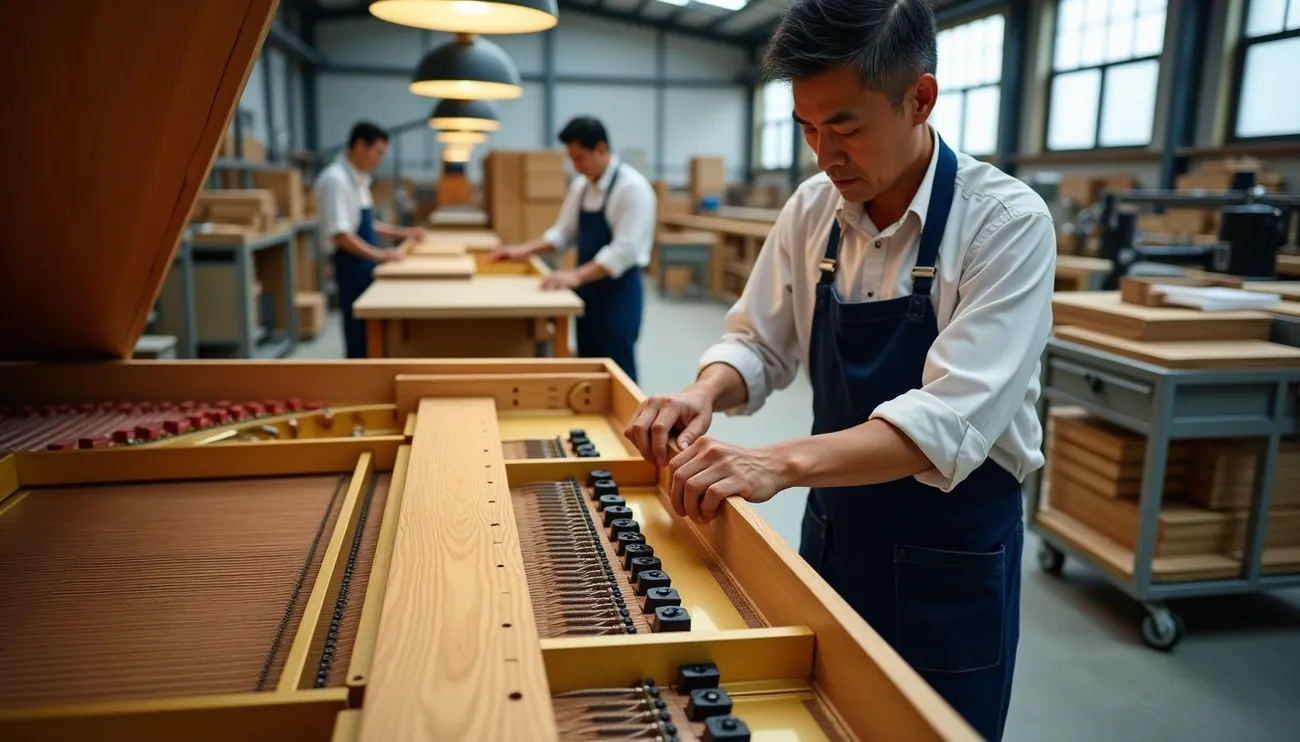
Most piano buyers never learn the manufacturing secrets that separate legendary makers from mass producers. Yamaha has operated its own dedicated wood mill in Hokkaido, Japan for more than fifty years [5]. Kawai emerged from Yamaha itself when Koichi Kawai, Yamaha’s lead engineer, started his own company in 1927. By 1950, his small workshop had grown to produce over 1,500 pianos annually [5].
These two Japanese giants built their reputations through completely different approaches to piano manufacturing. Yamaha chose vertical control – owning forests, foundries, and every step between raw materials and finished pianos. Kawai focused on engineering innovation, spending millions to solve problems other manufacturers accepted as unchangeable.
Their contrasting philosophies created two distinct schools of piano design that still shape the industry today. The manufacturing decisions they made decades ago explain why these brands earn institutional trust worldwide – and why families in Dubai and across the UAE choose vintage Japanese pianos over cheaper modern alternatives.
From Master to Student: The Kawai Story Begins
When an 11-Year-Old Cart Changed Piano History
Picture an 11-year-old boy in 1897 Hamamatsu, sawing wood in his father’s wagon-making shop. Koichi Kawai had just built something unusual – a pedal-driven cart that actually worked [1][5]. The contraption caught the eye of a neighbor who was struggling with his own mechanical project: assembling an upright piano from imported parts.
That neighbor happened to be Torakusu Yamaha, a watchmaker who had started building organs [4]. When Yamaha saw the boy’s cart, he recognized talent that couldn’t be taught. The next day, he offered Koichi an apprenticeship [1].
This moment shaped piano manufacturing in Japan. At Yamaha’s Nippon Gakki Co., Koichi led the research team that brought pianos to Japanese homes [1]. His breakthrough came in 1907 when he completed the first entirely Japanese-made piano action [3]. Before this, every Japanese piano manufacturer imported actions from America or Germany [4]. Koichi’s patents followed, one after another [1].
The Split That Created Competition
The 1920s brought trouble to Nippon Gakki [1][4]. New management took control and began diversifying away from pianos [4][2]. Koichi watched his life’s work change direction. In 1927, convinced that excellence would find its own path, he made a decision that changed everything [1].
Seven colleagues joined him when he left to start the Kawai Musical Instrument Research Laboratory [1][4]. Their first factory was barely more than a warehouse [5]. Their goal remained simple: build the world’s finest piano [1].
The Showa type piano emerged first under Koichi’s direct supervision [5]. In 1928, they completed their first grand piano, the Hiradai 1 [5]. Word spread through Hamamatsu’s tight musical community. Koichi’s “free action” design earned patents for both the mechanism and a new soundboard approach [5].
Growth came quickly. By 1929, they had renamed the company Kawai Musical Instrument Manufacturing [4]. But success brought new challenges. Finding craftsmen who met Koichi’s standards required extensive training programs [1]. Quality materials remained scarce in post-war Japan [1]. Distribution networks had to be built from nothing [1].
War, Reconstruction, and the Foundation of Modern Kawai
World War II stopped piano production entirely in 1937 [4]. The factory switched to aircraft parts and gliders [4][5]. When peace returned in 1945, the company needed complete rebuilding [5].
Koichi hadn’t abandoned his dream. Piano production resumed in 1948 [4]. The first postwar grand piano, No. 500, rolled out in 1950 – built from blueprints Koichi carried in his memory [5]. Every instrument received his personal inspection [5]. His manufacturing philosophy never wavered: “Sell the technology first before selling the instrument” [5].
The strategy worked. By the early 1950s, over 500 employees were producing more than 1,500 pianos annually [1]. In 1953, the Japanese government honored Koichi with the Medal with Blue Ribbon – the first musical instrument maker to receive this recognition [3][1].
When Koichi passed away in 1955, his 33-year-old son Shigeru took control [5][4]. The foundation was solid: engineering precision and quality that refused compromise [1]. This philosophy explains why families today choose vintage Japanese pianos over modern mass-produced alternatives. The craftsmanship Koichi demanded in 1927 still resonates through every vintage Yamaha and Kawai piano we source from Japanese homes.
Yamaha’s Manufacturing Strategy: Complete Control From Forest to Piano
Wood Selection That Starts in the Forest
Walk into any Yamaha piano and you’ll hear wood that began its journey in Yamaha’s own forests. The company operates Kitami Mokuzai Co., Ltd. in Monbetsu County, Hokkaido, where craftsmen mill premium spruce specifically for piano soundboards [6]. Picture this: mountains of timber arrive daily, but only the top 15 percent makes it into actual pianos [23].
This isn’t random selection. Yamaha’s technicians examine grain patterns, density, and resonance qualities before any wood touches a piano. In 2016, they signed agreements to establish sustainable Sakhalin spruce forests throughout the Okhotsk region [6]. By 2021, these “Oto-no-Mori” forest initiatives had expanded across Hokkaido [6]. Workers planted 600 Sakhalin spruce seedlings in October 2022 alone [6]. Industrial helicopters now track 35 hectares of forest from 80 meters above, gathering data for long-term cultivation research [6].
The Foundry Advantage Most Piano Companies Can’t Match
Most piano manufacturers buy their cast iron frames from suppliers. Yamaha casts its own at the Iwata foundry, making it one of the only piano companies worldwide to control this crucial component [23]. Their metallurgists developed the V-Pro vacuum shield mold process, creating plates that withstand over 40,000 pounds of string tension [8] [23]. The technology proved so effective that competitors adopted Yamaha’s process for their own production [23].
At the Kakegawa factory, 30 minutes from Hamamatsu headquarters, master builders assemble CF, SX, CX, and GC series grands, plus YUS and U series uprights [24] [23]. Five master technicians work exclusively on flagship CFX concert grands in the dedicated Concert Piano Workshop [24]. Workers string piano wire by hand rather than machine [24]. Each piano receives four tunings – robots handle the first two, human ears complete the final two [24].
Global Production With Japanese Standards
Yamaha’s Indonesian factory outside Jakarta opened in 1974, starting piano production in 1984 [23]. This facility assembles P22 school pianos, b-Series uprights, and GB1K models, including Disklavier and Silent Piano variants [23]. Over 1,200 workers staff this plant, receiving regular cross-training from Japanese craftsmen [23]. Here’s the key detail: all grand piano soundboards still ship from Japan to Indonesia for assembly [23].
President Takuya Nakata announced 35 billion yen in domestic production investments through March 2025 [7]. The company integrated Yamaha Music Manufacturing Japan Corp. into headquarters and added facilities at Sakuraba Mokuzai Co. in Kita-Akita [7]. This strategic shift reversed decades of overseas expansion as weak yen economics and declining Chinese sales prompted refocus on Japanese manufacturing as the technical hub [7].
Quality Control That Extends to Parts You Never See
Yamaha seasons piano components specifically for destination climates before shipment [8]. Pianos heading to Dubai receive different wood treatment than those bound for humid climates. The company designs and builds the machinery that builds the pianos, from specialized jigs to nanoparticle finish application robots [25]. Quality inspectors examine even the back panels of uprights – surfaces customers never see [24].
This vertical integration eliminated the supplier dependencies that plague other piano companies [25]. Yamaha produces its own piano wire, casts frames, mills wood, manufactures action parts, and even fabricates screws and hinges in-house [25]. Supply chain measures reduced lead times by 20 to 30 percent versus 2021 peaks, while critical component inventory expanded to three to six months for digital processors [26].
When you press a key on a vintage Yamaha piano, you’re experiencing the result of this complete manufacturing control – wood selected in Japanese forests, cast iron frames made in Yamaha foundries, and assembly by craftsmen trained to standards that haven’t changed in decades.
Kawai’s Manufacturing Innovation: Engineering Solutions to Real Problems
The Millennium III Action breakthrough
During the 1960s, Kawai’s engineers spotted a problem that other piano manufacturers simply accepted as “normal.” Wood components in piano actions expanded and contracted with humidity changes, making the touch feel different on humid days versus dry days. When you pressed a key in summer, it felt different than in winter.
In 1970, Kawai invested millions of dollars to solve what seemed unsolvable [11]. Their first attempt used ABS-Styran, a composite material that stayed stable regardless of humidity. Professor Abdul Sadat at California Polytechnic University tested these parts in 1998 and confirmed they outperformed traditional wooden components in both strength and dimensional stability [27].
The real breakthrough came in 2002 with the Millennium III Action – what Kawai called the “5th Evolution” of piano touch [11]. Engineers mixed carbon fiber into their existing composite, creating ABS-Carbon that was 90% stronger than the original [11]. The lighter weight made grand piano actions 25% faster and upright actions 16% faster than conventional wooden mechanisms [28].
Even the smallest details mattered. Engineers added microscopic surface texture where the jack meets the knuckle, giving pianists unprecedented control when playing very softly [11].
Tapered soundboards across every product line
While Yamaha reserves tapered soundboards for their premium models, Kawai applies this technique throughout their entire range. Each soundboard starts with straight-grained, quarter-sawn solid spruce [29]. Craftsmen then taper specific regions to control exactly how the wood vibrates [29].
Every GL series grand piano receives a soundboard that meets strict resonance standards [29]. The K Series professional uprights get the same treatment [30]. This consistent approach means even entry-level Kawai pianos benefit from advanced soundboard engineering [31].
Robots and craftsmen working together
When Hirotaka Kawai became president in 1989, he made a crucial decision. Rather than choosing between tradition and technology, he invested tens of millions of dollars to blend both [13]. Robots handle repetitive precision tasks while human craftsmen focus on the artistry that machines cannot replicate [13].
This philosophy earned recognition from the industry itself. Kawai received over 50 major international awards [11] and won the 2022 Music Merchandise Review Acoustic Piano Line of the Year [14]. The awards came from dealers and industry professionals who understand what separates exceptional manufacturing from ordinary production.
How Manufacturing Decisions Earned Institutional Trust
Concert halls choose quality over marketing
Performance venues select pianos based on sound, reliability, and audience impact – not advertising budgets. Yamaha operates the only full corporate office in Canada dedicated entirely to supporting musicians, educators, and institutions [15]. The Royal Conservatory of Music, Roy Thomson Hall, and universities across Canada choose Yamaha after rigorous evaluations [15]. These institutions value superior tone, reliability, and long-term performance [15].
Kawai earned parallel recognition through competition results. At the 2021 International Chopin Competition, three out of twelve finalists chose Shigeru Kawai grand pianos for their performances [9]. The 12th Hamamatsu International Piano Competition in 2024 told a similar story: three of six finalists selected Shigeru Kawai, surpassing Steinway’s two and Yamaha’s one [9]. More than 40% of the 87 contestants who reached the first round chose to play Shigeru Kawai [9].
Musical instrument dealers – not marketing departments – determine MMR award recipients. Kawai won four MMR Acoustic Piano Line of the Year awards and received over 55 major international awards for excellence [10]. This recognition comes from industry professionals who understand instrument quality [10].
Production expansion follows demand
Kawai announced a 4 billion yen investment for a new Indonesian factory in Karawang, responding to digital piano market growth [9]. The facility will double digital piano production capacity in Indonesia when it opens in 2026 [9]. Automated manufacturing processes suggest improved profitability [9].
The 20,000 square meter construction project targets Q3 2025 preparation and Q2 2026 completion [16].
Climate adaptation through wood seasoning
Yamaha operates three distinct seasoning processes: wet, dry, and superdry lines [17]. Pianos for the United States receive superdry treatment, accounting for central heating and air conditioning that create arid indoor conditions [17]. Japanese and Asian markets receive wet-line treatment for humid island climates [17]. European markets get dry-line processing [17].
These differentiated processes began in 1963 after early U.S. imports experienced seasoning problems around 1960 [17].
Quality consistency through craftsman training
Japanese craftsmen conduct regular cross-training sessions at Yamaha’s Indonesian facility. This maintains manufacturing consistency across global production sites while preserving technical standards established at Japanese factories.
The Technical Differences That Matter
String length and tension: Two distinct philosophies
When you press a piano key, the hammer strikes a string stretched under thousands of pounds of tension. Yamaha chooses shorter, higher-tension strings across comparable models. The U1’s longest bass string measures shorter than the Kawai K300. This design creates brighter, clearer projection in the mid-range and treble [12].
Kawai takes the opposite approach. Longer strings under lower tension produce more resonant bass, longer sustain, and greater cabinet vibration [12]. When you play a low C on a Kawai upright, the entire piano cabinet resonates with the string’s movement. Yamaha’s shorter strings focus the sound more directly forward.
Soundboard tapering: Where craftsmanship shows
Picture a violin soundboard – thicker in some areas, thinner in others to control how it vibrates. Kawai applies this principle across nearly every piano they build, from uprights to grands, except the entry-level K15 [12]. Each soundboard receives strategic tapering to control resonant movement in specific regions.
Yamaha reserves this labor-intensive technique for only their top two grand series: the CF and SX lines [12]. Tapered soundboards deliver improved sustain, better response, and superior dynamic range compared to flat alternatives [12].
Key stick engineering: The feel under your fingers
Kawai extends the wooden lever inside each key 1 to 3 centimeters longer than comparable Yamaha models [12]. This affects how the piano responds to your touch. When you play rapid passages or control dynamics from the front edge of the keys, those extra centimeters provide faster repetition and better control [12].
Action materials: Wood versus composite solutions
While Yamaha replaced wooden jack components with ABS plastic in select models [12], Kawai invested millions to develop composite materials throughout entire actions [18]. Their ABS-Carbon combination increased part strength by 90% [18].
This difference stems from philosophical approaches to humidity problems. Kawai’s engineers recognized wood’s mechanical limitations in the 1960s and spent decades developing composite solutions, first introduced in 1970 [18]. The sustained research investment led to their breakthrough Millennium III Action thirty years later [18].
What These Manufacturing Secrets Mean for Piano Buyers
Both companies built their legendary status through manufacturing choices that most competitors avoided. Yamaha’s control extends from Hokkaido forests to proprietary casting processes, eliminating the supplier dependencies that create inconsistencies in other pianos. Kawai’s million-dollar investment in composite research during the 1960s solved humidity problems that wooden actions couldn’t handle.
Their different approaches created instruments with distinct personalities. Yamaha’s shorter scale design with higher string tension produces clear projection and bright treble response. Kawai’s longer strings and tapered soundboards create deeper resonance and longer sustain. Both earn trust from concert halls and competitions worldwide.
The manufacturing details I’ve explained here reveal why vintage Japanese pianos from 30 to 50 years ago often outperform newer models at the same price point. When Yamaha controlled every component from their Hamamatsu factory, and when Kawai hand-built each action with uncompromising standards, these companies produced instruments that modern mass production struggles to match.
Understanding these manufacturing secrets helps explain why a carefully selected vintage Japanese piano delivers superior touch and tone compared to cheaper new alternatives or digital instruments in the same price range.
References
[1] – https://remenyi.com/blogs/remenyi-news-events/yamaha-vs-kawai-why-yamaha-pianos-are-the-clear-choice-for-canadian-musicians?srsltid=AfmBOoo9L1BylVjvQlwJQ3L4gk2cw5KWQRfc_4NwGkGK40zIGMayTVOC
[2] – https://millersmusic.co.uk/blogs/blog/the-philosophy-behind-kawai-pianos?srsltid=AfmBOoqXHUwR5OIYLwKFLCoyIXbq_0WTyyTJgS6HPSCx6PFPfbk2rh-8
[3] – https://kawaius.com/company/koichi-kawai/?srsltid=AfmBOop9z729NlAPwMM2DeBQVwP1-9QSTNEC36m1SxV8oAPM9cfhD_ou
[4] – https://www.sykespianos.co.uk/post/the-history-yamaha-pianos
[5] – https://www.encyclopedia.com/books/politics-and-business-magazines/kawai-musical-instruments-manufacturing-co-ltd
[6] – https://www.kawai.de/blog/spiritoso-the-story-of-koichi-kawai/
[7] – https://en.wikipedia.org/wiki/Kawai_Musical_Instruments
[8] – https://www.kawai-global.com/company/history/
[9] – https://www.kawai.co.jp/en/brand/Legacy/
[10] – https://europe.yamaha.com/en/musical-instruments/pianos/explore/philosophy/stories/001.html
[11] – https://blog.rivertonpiano.com/2022/01/15/where-are-yamaha-pianos-made/
[12] – https://www.mencheymusic.com/acoustic_and_digital_pianos/yamaha-grand-pianos/
[13] – https://www.cunninghampiano.com/blogs/blog/yamaha-piano-secrets-revealed?srsltid=AfmBOoot_tBXazGY0fWtwpROiyPAgTsihQK8ozqP_SOsIOcTxQEfMpiN
[14] – https://www.asahi.com/ajw/articles/15166889
[15] – https://denver.classicpianos.net/what-sets-yamaha-pianos-apart/?srsltid=AfmBOoq1y2aew89KHDvtRm_atOe6xGY_Q9NKuq7DJ95bGanaWRUIYfcA
[16] – https://portersfiveforce.com/blogs/how-it-works/yamaha
[17] – https://kawaius.com/technology/piano-action/?srsltid=AfmBOop_S_aWnl0rhGjvG8VcoClphWQf4uM7k2jbEORDVqQtE3dlBfGv
[18] – https://alamopianogalleries.com/pages/kawai-millennium-iii-grand-piano-action-superior-performance-unmatched-technology?srsltid=AfmBOorB9UfyYut2gp9l6txck7bPc15_N-tGN0A9axY6I7J_u9jS2-Sf
[19] – https://kawaius.com/faq/what-is-the-millennium-iii-action?srsltid=AfmBOooCj_2cDpg7kz2cD3JkXPOirrMu–4oe9vFEpiV5QPOH_EI1fTZ
[20] – https://www.kawai-global.com/product/gl-40/
[21] – https://www.kawai-global.com/product/k-400/
[22] – https://kawai.com.au/the-essential-keys/
[23] – https://www.kawaipiano.com.my/pages/about-us-hirotaka-kawai?srsltid=AfmBOorG-tYDBaVg-XGi5P4KOoCbTaBdA1BTpvhNWbzUKkDTB-y8we5B
[24] – https://alamopianogalleries.com/pages/kawai-pianos-advanced-technology-meets-unbeatable-value?srsltid=AfmBOorx_o9INfOTU5HzWW_EhQUu0ovFFF5TAo7P2paNQfp1vgf4VoVx
[25] – https://remenyi.com/blogs/remenyi-news-events/yamaha-vs-kawai-why-yamaha-pianos-are-the-clear-choice-for-canadian-musicians?srsltid=AfmBOorJwy3muBFBOkpAz2iGIbuWpOsBGnTc5CTlNDqh_Pd-zzivznL1
[26] – https://www.hibiki-path-advisors.com/en/engagement/post-4304/
[27] – https://www.hartlandpiano.com/kawaivsyamaha.html
[28] – https://www.instagram.com/p/DMZpONRuhco/
[29] – http://pianofinders.com/techtalk/seasoning.htm
[30] – https://www.merriammusic.com/blog/yamaha-vs-kawai-pianos/
[31] – https://kawaius.com/technology/piano-action/?srsltid=AfmBOoqu4mxOPR7EmqyHaoRpyp668YMWmVUFaiSU4NuanB1Lbegd6j3L
