Yamaha Upright Piano Showdown: U1 vs U3 vs YUS – Which Should You Buy? [2026]
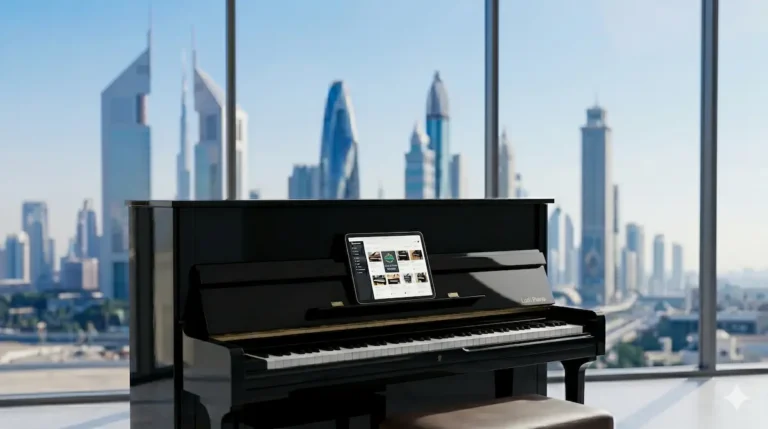
Families in Dubai face a real choice when selecting a Yamaha upright piano: the U1, U3, or YUS series. Each model comes from the same Kakegawa factory in Japan, but the differences matter for your home and your children’s musical development.
Here’s what you need to know from our experience importing these pianos directly from Japanese homes to our Ras Al Khor showroom. The U1 stands 48 inches tall – perfect for apartments and smaller spaces. The U3 measures 52 inches, giving you a larger soundboard that produces richer bass tones. The YUS series uses the same premium materials found in Yamaha’s concert grand pianos.
After 15 years working with Japanese acoustic pianos, we’ve learned that height determines sound quality more than any marketing claims. When you press a key on the taller U3, longer strings vibrate through a bigger wooden soundboard. You hear the difference immediately.
This guide breaks down exactly what these four inches of height difference mean for sound, touch, and value. We’ll explain which model fits your space, budget, and musical goals – without the sales pressure you’ll find elsewhere in Dubai and the UAE.
Physical Specifications: U1 vs U3 vs YUS Series Side-by-Side
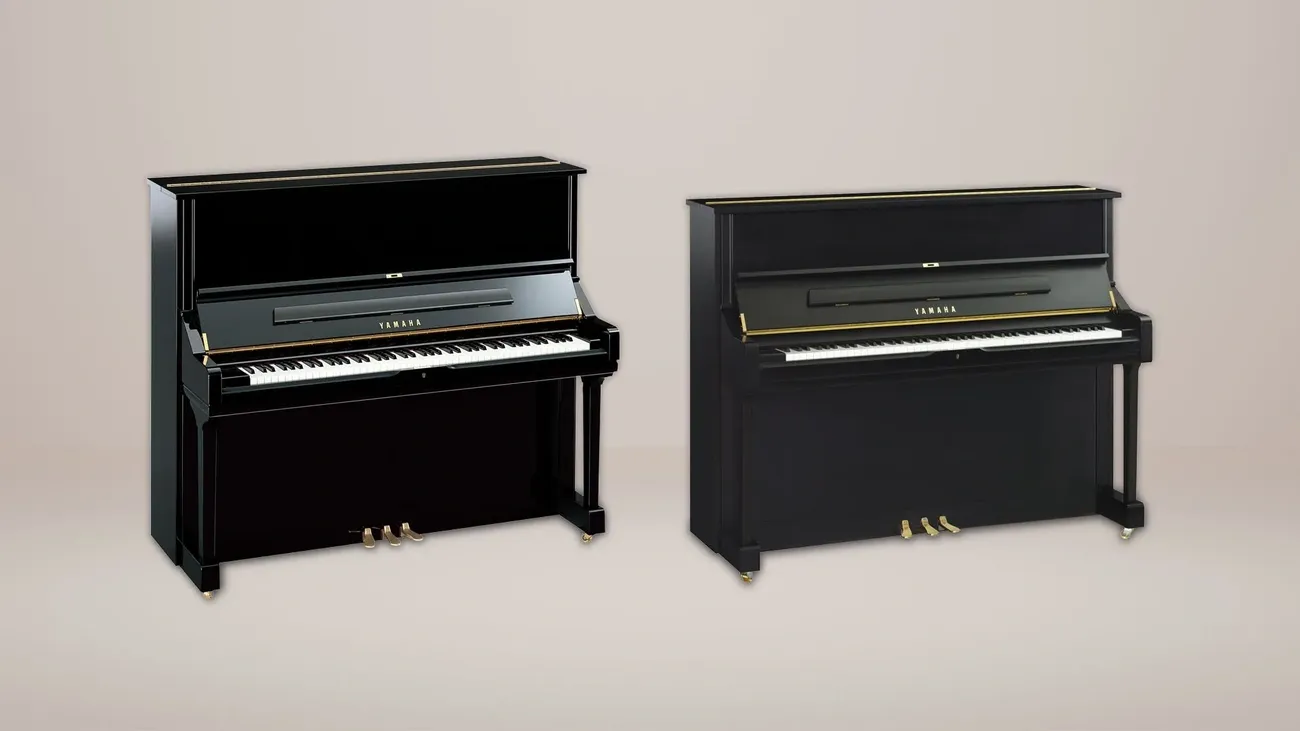
Image Source: Music Exchange
Height, Weight and Cabinet Dimensions Breakdown
Think of piano dimensions like room acoustics. The U1 sits at 48 inches tall, 60 inches wide, and 24 inches deep, weighing 502 lbs [6]. The U3 stretches to 52 inches tall with the same 60-inch width but extends to 26 inches deep, weighing 517 lbs [6]. Those four extra inches create a significantly larger acoustic chamber inside.
The YUS models follow clear patterns. YUS1 matches the U1 footprint exactly: 48 inches tall, 60 inches wide, 24 inches deep, weighing 502 lbs [7]. YUS3 mirrors the U3 at 52 inches tall and 26 inches deep, weighing 517 lbs [7]. The flagship YUS5 uses the same cabinet as the YUS3 but weighs 530 lbs due to premium German components [7].
From our Ras Al Khor workshop experience: U3 and YUS3 models need two technicians for safe transport. The U1 and YUS1 fit more easily through Dubai villa doorways and narrow staircases.
Soundboard Size and String Length Comparisons
Soundboard area directly controls volume and tonal richness. The U1 and YUS1 feature 2,137 square inches of solid spruce soundboard [6] [7]. The U3, YUS3, and YUS5 provide 2,369 square inches [6][2] – an 11% increase in vibrating wood surface.
Bass strings tell the same story. The U1’s lowest string measures 46.8 inches, while the U3 extends to 47.5 inches [6]. This 0.7-inch difference produces noticeably deeper bass frequencies that you feel in your chest when playing forte passages.
Build Quality: Japan Manufacturing Standards
Every Yamaha upright piano in the U and YUS series comes from Kakegawa factory in Japan [3]. Soundboards start as hand-selected spruce from Yamaha’s Kitami Mill in Hokkaido [3]. Five spruce back posts provide structural support, with hard maple bridges and pinblocks across all models [6][2].
The YUS series uses German piano wire and German hammer felt [7] – materials absent from U1 and U3 models. Factory location matters more than marketing claims. Indonesian-built B-series pianos lack the structural integrity and tonal depth of their Japanese cousins [4].
Caster Configuration and Mobility Differences
Caster quality reveals Yamaha’s attention to detail. U1 and U3 models use single casters [7]. YUS series employs double brass casters [7] that protect Dubai’s marble floors and allow smoother positioning during tuning sessions.
We stock U1H, U30A, YUS1, YUS3, and YUS5 models imported directly from Tokyo homes. Visit our showroom to feel these specification differences yourself.
Sound Quality, Touch Response and Performance Analysis
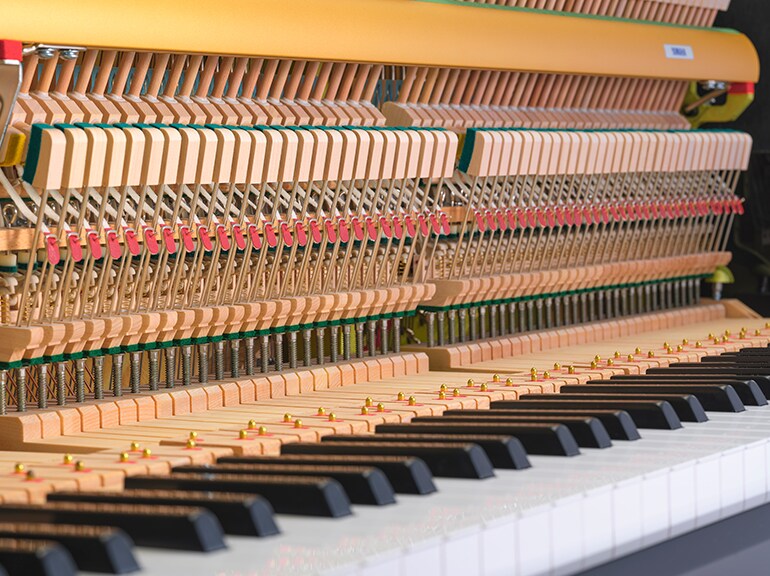
Image Source: Yamaha Music Store
Tonal Character: Bright U1 vs Rich U3 vs Refined YUS
Sound tells the real story. The U1 produces a brighter, more focused tone with higher tension strings that create a metallic attack [5]. This cutting clarity works perfectly for pop, blues, and ensemble playing where you need to cut through other instruments.
The U3 gives you something different – richer, warmer tones that fill a room more completely [6]. Those four extra inches of height create a larger resonating chamber that you hear immediately when playing bass notes. The YUS series takes this further with concert-quality hammer felt borrowed from Yamaha’s CFX flagship grand piano [7]. You’re getting grand piano expression in upright form.
Bass Response: Why Size Matters
Here’s where the differences become obvious. The U3’s extended soundboard vibrates more freely through Yamaha’s Floating Support System, producing richer bass and mid-range tones [8]. When families visit our Ras Al Khor showroom, they notice the U3’s deeper bass notes compared to the U1’s precise but lighter low end.
The YUS series goes further with its tone escapement system that releases sound from inside the cabinet [7]. You get clarity and power that most uprights simply cannot match.
Touch and Key Response
Advanced students feel the difference in key response. The U3’s taller structure allows longer hammer shanks, creating more sensitive touch that responds to subtle finger pressure [9]. YUS pianos receive hand voicing and regulation by master technicians in Kakegawa, ensuring each key feels exactly like the finest grand pianos [7].
Our U1H and U30A models provide smooth, consistent action that works well for developing students who need reliable key response.
Materials That Shape Sound
Hammer felt quality determines how your piano expresses music. The YUS series uses the same dense felt found in CFX concert grands [7], while U-series models use materials selected specifically for each model [8]. This affects dynamic range and tonal color at every volume level [10].
Two Sound Enhancement Systems
The U3 uses Yamaha’s Floating Support System, borrowed from grand piano design, allowing the soundboard to vibrate freely [8]. The YUS proprietary tone escapement system releases interior sound, creating better physical resonance [7].
Recording Studio Choice: The U1 Advantage
Professional recording studios choose Yamaha uprights, specifically the U1 model, for reliable bright sound, excellent clarity, and responsive action [1]. Visit our showroom to hear the YUS1, YUS3, and YUS5 for recording work.
Pricing, Value and Expert Model Recommendations
Image Source: Vancouver Music Gallery
New Yamaha Upright Piano MSRP Comparison 2026
Brand new Yamaha uprights command serious money in Dubai. The U1 starts at AED 44,059.61, while the U3 jumps to AED 57,645.79 [11]. YUS models cost even more – YUS1 at AED 57,278.60, YUS3 at AED 69,396.00, and the flagship YUS5 reaching AED 77,107.08 [12].
But here’s what matters for families in the UAE: these prices reflect modern manufacturing compromises. Today’s Yamaha factory produces thousands of pianos monthly to meet global demand. Compare this to 30-40 years ago, when Yamaha built every single component inside their Hamamatsu factory using Japanese craftsmen.
Used Yamaha Upright Piano Market: The Real Value Story
‘Used’ Yamaha upright pianos from the 1980s cost AED 1,101.580 to AED 1,835.970 for instruments we import from Japanese homes [2]. A well-maintained 1980s model typically runs AED 1,285.180 to AED 1,468.780 [2].
Think about this: a fully refurbished 1980 U3 costs less than AED 20,000. That same piano was built when Yamaha used exclusively Japanese materials and traditional methods. The new U3 costs nearly AED 58,000 but contains outsourced components to compete with cheaper brands.
At our Ras Al Khor showroom, we stock properly acclimated Japanese domestic models. Each piano gets inspected by our Tokyo technicians before shipping to Dubai.
Best Models for Home Practice: U1H, U10BL, and U30A
The U1H (produced 1971-1990) offers exceptional durability that music institutions trust [13]. We maintain inventory of U1H, U10BL, and U30A models perfect for developing students.
These instruments feature the original Hamamatsu build quality – solid spruce soundboards, premium hammer felt, and Japanese steel strings throughout.
Professional-Grade Options: YUS1, YUS3, and YUS5 In-Stock
Our YUS inventory includes hand-wound German strings and concert-grade hammer felt borrowed from CFX grand pianos [7]. Visit our showroom to test the YUS1, YUS3, and YUS5 side by side.
Yamaha U1 vs U3: Which Holds Value Better
Both models appreciate consistently [14]. A 1980 U3 bought for AED 9,187.50 in 2006 gained 75% value by 2023 [15]. Japanese-built Yamahas rarely depreciate when properly maintained.
Budget-Conscious Alternative: Kawai NS 15 and Petrof 126
The Kawai NS 15 (1985-1995) delivers touch quality matching Yamaha U2 with superior tonal warmth [16]. Our Petrof 126 inventory provides European craftsmanship at competitive pricing.
Yamaha Upright Piano Comparison: Quick Reference for Dubai Families
|
Specification |
U1 |
U3 |
YUS1 |
YUS3 |
YUS5 |
|
Height |
48 inches |
52 inches |
48 inches |
52 inches |
52 inches |
|
Width |
60 inches |
60 inches |
60 inches |
60 inches |
60 inches |
|
Depth |
24 inches |
26 inches |
24 inches |
26 inches |
26 inches |
|
Weight |
502 lbs |
517 lbs |
502 lbs |
517 lbs |
530 lbs |
|
Soundboard Area |
2,137 sq. inches |
2,369 sq. inches |
2,137 sq. inches |
2,369 sq. inches |
2,369 sq. inches |
|
Bass String Length |
46.8 inches |
47.5 inches |
Not mentioned |
Not mentioned |
Not mentioned |
|
Manufacturing Location |
Kakegawa, Japan |
Kakegawa, Japan |
Kakegawa, Japan |
Kakegawa, Japan |
Kakegawa, Japan |
|
Piano Wire |
Standard Yamaha |
Standard Yamaha |
German |
German |
German |
|
Hammer Felt |
Standard Yamaha |
Standard Yamaha |
German (CFX concert-grade) |
German (CFX concert-grade) |
German (CFX concert-grade) |
|
Caster Type |
Single casters |
Single casters |
Double brass casters |
Double brass casters |
Double brass casters |
|
Special Sound System |
N/A |
Floating Support System |
Tone Escapement |
Tone Escapement |
Tone Escapement |
|
Tonal Character |
Bright, metallic attack |
Rich, greater projection |
Concert-quality, refined |
Concert-quality, refined |
Concert-quality, refined |
|
Touch Sensitivity |
Smooth, consistent |
More sensitive (longer hammer shanks) |
Master-regulated, grand piano-like |
Master-regulated, grand piano-like |
Master-regulated, grand piano-like |
|
2026 MSRP (AED) |
44,059.61 |
57,645.79 |
57,278.60 |
69,396.00 |
77,107.08 |
|
Best For |
Pop, blues, ensemble, recording studios, developing students |
Advanced players, richer bass needs |
Professional home practice |
Professional performance |
Flagship professional performance |
|
Used Market Value (30-40 years old) |
AED 1,101.58 – 1,835.97 |
AED 1,101.58 – 1,835.97 |
Not mentioned |
Not mentioned |
Not mentioned |
What This Table Means for Your Family: Every model uses solid spruce soundboards sourced from Yamaha’s Hokkaido mill and the same structural components – five spruce back posts with hard maple bridges. The difference lies in materials and voicing quality. YUS models receive individual attention from master technicians who adjust each hammer and key to concert standards.
Visit our Ras Al Khor showroom to experience these differences firsthand. We import directly from Tokyo and properly acclimate each piano for Dubai’s climate before delivery to your home.
Choose the Right Piano for Your Family in Dubai
Your choice comes down to three factors: your child’s current level, your home’s space, and your budget.
The U1 works well for beginning and intermediate students. Its bright sound cuts through practice room noise, and the compact size fits most Dubai apartments and villas.
The U3 gives advancing players the richer bass tones they need for classical pieces and ensemble work. Those four extra inches of height create a noticeably fuller sound.
The YUS series brings concert hall materials into your home. These pianos use the same hammer felt found in Yamaha’s flagship concert grands – perfect for serious students and adult players who want professional-quality touch and tone.
We keep all these models at our Ras Al Khor showroom, properly adjusted for UAE humidity after shipping directly from Japan. Come hear the differences for yourself. Touch the keys, listen to the bass response, and decide which piano deserves a place in your family’s musical journey.
Book your showroom visit today – we’re here to guide you to the right choice, not pressure you into any sale.
FAQs
Q1. Is the Yamaha U3 worth the extra cost compared to the U1? If you have the space and budget, the U3 delivers noticeably richer tonal depth and enhanced dynamic expression, particularly in the bass register. However, the U1 provides excellent quality at a lower price point without significant compromise in sound or build quality, making it ideal for most home settings.
Q2. What makes the YUS series different from the U series pianos? The YUS series uses premium materials including German piano wire and concert-grade hammer felt borrowed from Yamaha’s CFX flagship grand piano. It’s designed for advanced players and professional use with master technician voicing, while the U series offers exceptional quality for intermediate to advanced players at a more accessible price.
Q3. Which Yamaha upright piano has the best sound quality? The YUS series (YUS1, YUS3, and YUS5) produces the fullest and richest sound among Yamaha uprights, representing the highest quality tier. The YUS models feature concert-quality materials and tone escapement systems that deliver grand piano-like expression rarely found in upright pianos.
Q4. How much bigger is the U3 compared to the U1? The U3 stands 4 inches taller at 52 inches versus the U1’s 48 inches, and is 2 inches deeper (26 inches vs 24 inches). This translates to an 11% larger soundboard area (2,369 square inches vs 2,137 square inches) and longer bass strings, producing noticeably deeper bass tones.
Q5. Which Yamaha upright is best for recording studios? The U1 dominates professional recording studios due to its characteristically bright sound, excellent clarity, and responsive action. Its metallic attack cuts through ambient noise effectively, making it particularly suitable for pop, blues, and ensemble recording applications.
References
[1] – https://usa.yamaha.com/products/musical_instruments/pianos/upright_pianos/u_series/specs.html
[2] – https://www.freeholdmusic.com/yamaha-japanese-upright-comparison-chart/?srsltid=AfmBOoqi1jmvfsdf3YrwFiVjvvIWnu7Vr_wUQIdtWsATm0l8jCTLVYbd
[3] – https://www.merriammusic.com/blog/pianos-blog/new-and-used-yamaha-u1-price/
[4] – https://usa.yamaha.com/products/musical_instruments/pianos/upright_pianos/u_series/u-series.html
[5] – https://markgoodwinpianos.co.uk/blog/are-yamaha-pianos-made-in-japan
[6] – https://www.merriammusic.com/blog/pianos-blog/piano-reviews/yamaha-u1-review/
[7] – https://muex.com/blog/yamaha-u1-vs-yamaha-u3/?srsltid=AfmBOoolkdW66haoXmLkawrNxz3zZppI8APaJRZSGeFuccPn864i3LXh
[8] – https://usa.yamaha.com/products/musical_instruments/pianos/upright_pianos/yus_series/yus-series.html
[9] – https://usa.yamaha.com/files/download/brochure/6/332556/AP6396_Upright_Brochure.pdf
[10] – https://faustharrisonpianos.com/yamaha-u1-vs-u3-what-is-the-difference/?srsltid=AfmBOoqJ4Xs-coyDRl3Yd5GRzx_Q4uxsnxsoFkOIrUjzkjh2pAE_hRx3
[11] – https://pianopricepoint.com/researching-pianos-hammer-felt-matters/
[12] – https://www.sageaudio.com/articles/studio-equipment/best-studio-upright-pianos-recording
[13] – https://muex.com/blog/yamaha-u1-vs-yamaha-u3/?srsltid=AfmBOooT2Xs5LL5NDWPpJEvXFJmK1vrLX0iSQF70yNnlMYdb_DYNI1L7
[14] – https://www.merriammusic.com/pianos/brands/yamaha/?srsltid=AfmBOorDd0q3x–k_TguvJ7etC6FrHQklC4adoAoAnkhMze3Xbf0vQD6
[15] – https://melodicamusicstore.com/products/yamaha-u1h-upright-piano-black-renewed?srsltid=AfmBOoqIgOpgVzsDB9VAQpDZSiMznEMMYlHF7rvQb5Swq_IzlUbmvC5H
[16] – https://www.melodiouspianoboutique.com/post/top-5-reasons-to-buy-a-yamaha-u1-or-u3-piano-in-singapore
[17] – https://markgoodwinpianos.co.uk/faq/investment
[18] – https://www.pianos.eu.com/2022/11/18/kawai-ns15-upright-piano-dorset-pianos/