Yamaha Upright Piano History: The Untold Story Since 1900
 ## Introduction
Yamaha upright piano history begins in 1900 with Japan’s first domestically built upright, a milestone that would reshape global piano manufacturing forever. By 1966, Yamaha was producing 100,000 instruments annually and claimed the title of the world’s largest piano manufacturer. This wasn’t just about quantity. The uprights built at Yamaha’s Hamamatsu factory between 1960 and 1990 represent some of the finest mechanical instruments crafted, with every component manufactured in-house by Japanese experts. The history of yamaha upright piano models reveals why these vintage instruments often outperform modern alternatives, especially in demanding climates like the UAE. I’ve sourced and restored hundreds of these pianos through our Tokyo office for families across Dubai. What I’ve witnessed is what 30 to 50 years of Japanese precision engineering means.
The birth of Japan’s first upright piano (1900-1927)
Torakusu Yamaha’s trip from reed organs to uprights
Torakusu Yamaha never intended to build pianos. His career began repairing medical equipment until 1887, when he repaired and tuned a broken reed organ at an elementary school in Hamamatsu. That repair sparked something. He built his own reed organ the same year and founded the Yamaha Organ Manufacturing Company in 1889 [1]. The company had hired 100 people by that year and sold nearly 250 organs each year to Japanese schools [2][3].
The leap to pianos required more than workshop intuition. Torakusu spent five months touring the United States in 1899. He visited Steinway & Sons’ New York factory and studied their methods [2]. He purchased machinery and materials, then returned to Hamamatsu to begin production. The first upright rolled out in 1900, followed by Japan’s first grand piano in 1902 [4][2].
Why uprights dominated the early Japanese market
Space dictated everything. Japanese homes and schools had no room for grand pianos. Interest in Western classical music was new [5][1], which meant most buyers were institutions or families who wanted compact, affordable instruments for education. Uprights fit that need. The domestic market absorbed nearly all production during this period, on account of Torakusu’s focus on establishing local manufacturing standards before attempting exports.
The 1904 St. Louis World’s Fair recognition
Torakusu sent one of his pianos to the 1904 St. Louis World’s Fair, where it received an Honorary Grand Prize [5][1][1]. This marked the first time a Japanese piano manufacturer earned international recognition. The award confirmed his manufacturing approach, but export markets remained difficult to penetrate. European and American buyers viewed Japanese craftsmanship with skepticism.
Early export challenges and European craftsmanship studies
Yamaha craftsmen traveled to Europe by the 1920s to study advanced production techniques [5][1]. The company invited Ale Schlegel, an expert piano technician from Germany, to visit the Nippon Gakki facilities in Hamamatsu in 1926 and discuss piano making in detail [5][1][1]. This consultation proved transformative. Schlegel’s insights influenced the quality standards that would later make yamaha upright piano models history so most important.
We source pianos built after these European consultations took hold at our Tokyo office. The difference in soundboard construction and action regulation between pre-1926 and post-1926 Yamaha uprights is measurable. This craftsmanship legacy translates to instruments that survive our extreme climate without structural failure for families in Dubai.
Yamaha upright piano models history: evolution through war and recovery (1930-1960)
Image Source: Facebook
Pre-war innovations in upright design
Yamaha staff had received instruction from German piano technicians by 1930 and acquired specialized techniques that went beyond Schlegel’s earlier consultation [4]. The company installed equipment for scientific analysis and measurement that same year and compiled data that confirmed the high quality of Yamaha pianos [4]. This wasn’t quality control alone. Acoustic labs and research centers opened to refine upright soundboard construction and hammer voicing. The scientific approach to wood selection and pin block lamination during this period established manufacturing standards that would define yamaha upright piano models history for decades.
World War II’s effect on upright production
Nippon Gakki’s advanced woodworking and laminating techniques, developed for musical instruments, caught military attention [2]. The Imperial Japanese Army then supervised the company’s conversion to manufacturing propellers for fighter aircraft, for Kawasaki’s Ki-43 fighter and Ki-48 bomber [2]. Piano production ceased by 1945 [3]. US bombing raids destroyed all but one of these factories [3] and nearly erased yamaha upright piano history from existence.
Post-war rebuilding and the FC upright series
Rebuilding began two years after the war’s end [3]. Yamaha released the FC concert grand piano to great acclaim in 1950 [5]. Spurred by that success, the company built new facilities because it wanted to make better pianos [5]. Our Tokyo office sources instruments from this rebuilding era because the craftsmanship reflects determination. Uprights built between 1950 and 1960 used Japanese domestic woods seasoned through natural methods before final processing.
Computer-controlled wood drying technology for uprights
Yamaha completed Japan’s first computer-controlled artificial drying room in 1956, where wood moisture content is adjusted to optimum levels after natural drying [5][6]. This addressed a problem most buyers ignore: wood movement. At Lotfi Piano Dubai, we know this matters in our AC-controlled homes. Uprights like our U3A and U1H models benefited from this drying state-of-the-art, which is why they survive Dubai’s climate without soundboard cracks.
The global upright piano boom and American expansion (1960-1990)
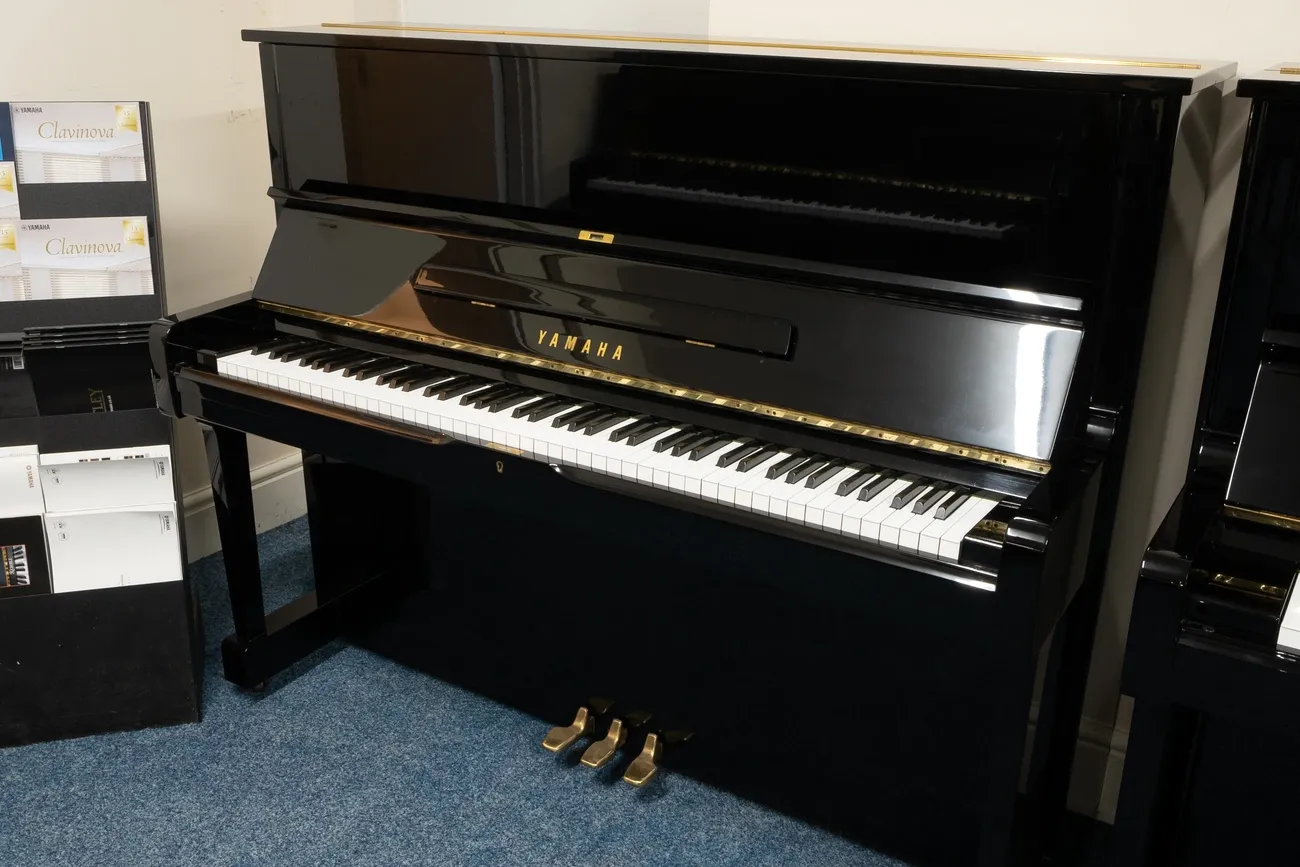
Image Source: The Piano Gallery
Why Yamaha chose uprights for US market entry
Production expanded massively during the 1960s as Yamaha began large-scale exporting to North America [7]. Uprights made strategic sense. American schools needed affordable and durable instruments. Grand pianos required too much floor space and cost twice as much. Yamaha engineers weren’t prepared for what happened next.
The U1 and U3 series that changed everything
The 48-inch U1 became one of the most popular uprights worldwide since the 1970s [7] [8]. Schools purchased multiple U-Series units at once [9]. Yamaha perfected mass production techniques by the mid-1970s and reliably produced quality instruments at volume [9]. The 52-inch U3 delivered strong bass lines and sparkling high notes through its colossal soundboard [8]. Our U3A and U1H models sourced from Tokyo represent this golden era of yamaha upright piano models history at Lotfi Piano Dubai.
Seasoned for destination: adapting uprights for different climates
Indoor North American environments proved drier than Japan [1]. So some 1960s Yamaha pianos developed dryness-related problems [1]. Research led to computer-controlled drying kilns [1]. Three seasoning processes existed in 1963: wet for Japan and dry for Europe, with superdry reserved for the United States [10]. This climate adaptation matters in our UAE showroom, where properly seasoned instruments survive AC environments.
Silent Piano technology: the upright revolution of 1993
Yamaha released the first Silent Piano in 1993 [11] and combined acoustic authenticity with headphone practice capability. Experience how this yamaha upright piano history translates into instruments built for your home at our Ras Al Khor showroom.
Modern Yamaha uprights: from YUS series to today’s innovations
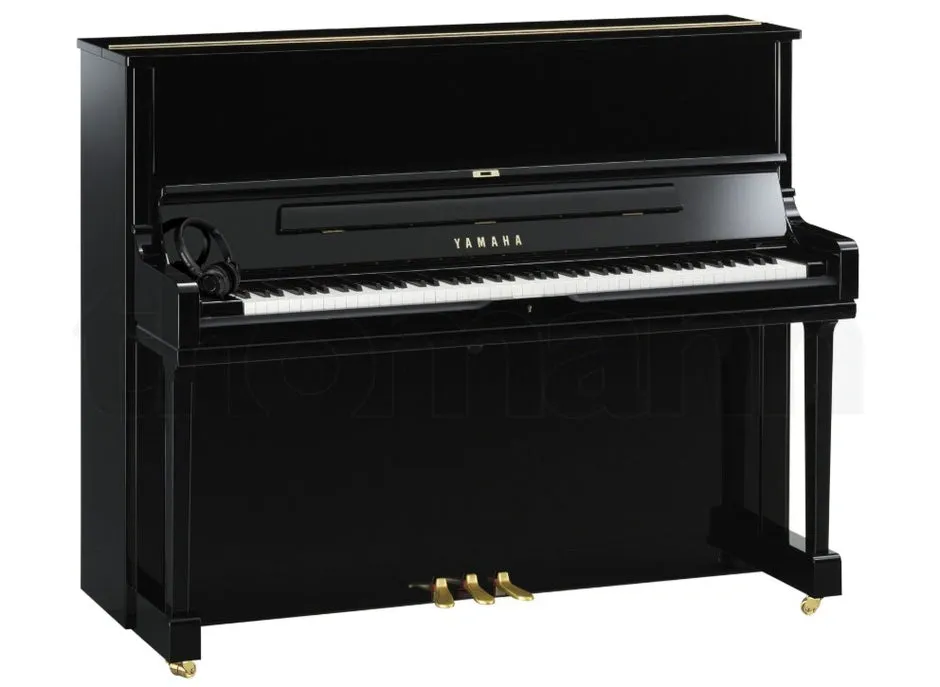
Image Source: The Piano Gallery
The premium YUS line and what makes it special
The YUS series represents Yamaha’s highest-tier upright manufacturing in 2026 [12]. Yamaha builds every YUS piano in Japan and uses materials from the flagship CFX concert grand, including the hammer felt and strings [13]. The YUS1 stands 48 inches tall. The YUS3 and YUS5 measure 52 inches [12]. The YUS5 stands apart with an opening front panel that boosts sound projection and longer keys to provide superior touch response [14].
Solid Asian spruce soundboards, hand-wound European bass strings, concert-quality hammer felt, V-Pro frames and aluminum action rails come standard across all YUS models [14]. A tone escapement system releases sound from inside the cabinet and physically immerses players in the acoustic experience [13]. Our Tokyo office sources YUS1, YUS3 and YUS5 models at Lotfi Piano Dubai for advanced students and professionals who need grand-piano-level performance in compact spaces.
Understanding current upright model designations (U1, U3, YUS)
The U1 measures 121cm tall with a focused, balanced tone [15]. The U3 stands 131cm with longer strings that produce deeper bass and richer resonance [15]. Yamaha has sold over 4 million uprights since 1967 [16]. U-series models dominate schools and conservatories around the world. The U3’s 40.4cm key depth versus the U1’s 37.5cm provides refined touch [17].
Which Yamaha upright models we recommend for homes and students
Our U3A and U1H models sourced from Japan deliver reliable action and clear tone that supports technical development for homes and students [18]. Visit our Ras Al Khor showroom and experience these climate-adjusted instruments.
How to identify quality in used Yamaha uprights
Inspect soundboards for cracks and get into frames for structural damage. Check hammer felt wear patterns [14]. Japanese domestic models that were managed to keep properly outlast neglected instruments by decades.
Conclusion
Yamaha upright piano history reveals why vintage Japanese domestic models outperform most modern alternatives, especially in climates like ours. Our Tokyo office sources U3A, U1H, and YUS instruments built with this century-old precision and adapted for Dubai homes. Visit our Ras Al Khor showroom to see how 1960-1990 Hamamatsu craftsmanship translates into instruments that survive AC environments without soundboard failure.
FAQs
Q1. When did Yamaha start manufacturing upright pianos? Yamaha produced Japan’s first upright piano in 1900, founded by Torakusu Yamaha who initially started with reed organs in 1887. This marked the beginning of what would become the world’s largest piano manufacturing company by 1966.
Q2. Which Yamaha upright piano models are most popular? The U1 (48 inches) and U3 (52 inches) models are the most acclaimed Yamaha uprights, with over 4 million units sold since 1967. The U1 offers balanced tone while the U3 provides deeper bass and richer resonance due to its longer strings and larger soundboard.
Q3. How can I determine the age of my Yamaha piano? You can find your piano’s age by locating the serial number and cross-referencing it with Yamaha’s year/month production table. The serial number will indicate the specific timeframe when your instrument was manufactured.
Q4. Are older Yamaha upright pianos still valuable? Yamaha uprights built between 1960-1990 in Japan often outperform modern alternatives due to superior craftsmanship and in-house manufacturing. However, condition matters significantly—properly maintained Japanese domestic models can outlast neglected instruments by decades, while poorly maintained pianos over 40 years old may have minimal value.
Q5. What makes the YUS series different from standard Yamaha uprights? The YUS series represents Yamaha’s premium upright line, built entirely in Japan using materials from the flagship CFX concert grand, including hammer felt and strings. These models feature solid Asian spruce soundboards, hand-wound European bass strings, and a tone escapement system for enhanced sound projection.
References
[1] – https://forum.pianoworld.com/ubbthreads.php/topics/1681316/Should_I_be_concerned_about_Ya.html
[2] – https://www.sykespianos.co.uk/post/the-history-yamaha-pianos
[3] – https://blog.rivertonpiano.com/2025/02/01/the-incredible-story-of-yamaha/
[4] – https://www.yamaha.com/en/about/history/innovation/episode-02/
[5] – https://hub.yamaha.com/pianos/p-history/a-brief-history-of-yamaha-pianos/
[6] – https://www.alamomusic.com/blogs/whats-new/a-brief-history-of-yamaha-pianos-alamo-music?srsltid=AfmBOooFEc63wPMOOe8Xihd5V7SDiWlIhOe1BqPaMDq_cgPjXkK9Lzgf
[7] – https://www.merriammusic.com/pianos/brands/yamaha/?srsltid=AfmBOopfZ94UZEQFnGPTWzXinQXuJBEGh_o2sBkgLlA02AiyvOa9qe_O
[8] – https://pianogallery.ae/blogs/post/comparison-of-yamaha-u-series?srsltid=AfmBOoo8B4m80Ragq8IP98caY3Go7dvXk94es8upnd0D7KVblmJ1ndnf
[9] – https://millersmusic.co.uk/blogs/blog/inside-the-yamaha-u-series?srsltid=AfmBOopks7tBsRxWzei_nwLTPP_BuEyMlvd52zGWJPn_cwCrogjtylkM
[10] – http://pianofinders.com/techtalk/seasoning.htm
[11] – https://marksonpianos.com/blog/a-closer-look-at-yamaha-silent-upright-pianos/
[12] – https://usa.yamaha.com/products/musical_instruments/pianos/upright_pianos/yus_series/index.html
[13] – https://mea.yamaha.com/en/musical-instruments/pianos/products/upright-pianos/yus-series/
[14] – https://www.coachhousepianos.co.uk/blog/articles/best-yamaha-upright-pianos-guide/?srsltid=AfmBOoqDqffC7-M_B-pcHOqVJrSj9VBkORAJ1xG64uNHV_O66tZbAdEt
[15] – https://faustharrisonpianos.com/yamaha-u1-vs-u3-what-is-the-difference/?srsltid=AfmBOooPDk3JOd4rV8-NV88X_oHe6kVBB8Bgx9X9YjHxYBtGb83AyBB7
[16] – https://usa.yamaha.com/products/musical_instruments/pianos/upright_pianos/index.html
[17] – https://markgoodwinpianos.co.uk/yamaha/difference-between-yamaha-u3-u1-pianos
[18] – https://www.brighamlarsonpianos.com/blogs/yamaha-piano-blog/best-yamaha-upright-piano-for-beginners?srsltid=AfmBOorQ5xW0V6MdVBIIaNGbn0k0-MTi99b_HwRbXmldXysTFWl08Tht