The Master Technician’s Guide: 5 Hidden Structural Checks Before Buying a Used Piano in Dubai
For many families, the journey of purchasing a used acoustic piano can feel overwhelming. Whether you are viewing an instrument in a private home, browsing an online marketplace, or visiting a retailer, the same anxieties often arise: How do we know if it is truly in good condition? What hidden flaws should we be looking for? Investing in a piano is not just a financial decision; it is an investment in your family’s musical future and the instrument’s life expectancy. You deserve absolute peace of mind.
Drawing upon over two decades of specialized experience in the premium acoustic piano trade—and as the founder of Lotfi Piano Dubai—I have seen every condition of used pianos imaginable. In this guide, I will share my master technician’s checklist for a thorough inspection. Read this post to the end, and you will understand exactly what to look for during your preliminary inspection to ensure you are bringing a high-quality, reliable instrument into your home.
1. The Soundboard: The Acoustic Engine (Most Important)
When families begin their search for a premium acoustic piano, they are often captivated by the polished cabinetry or the brand name on the fallboard. However, the true soul of the instrument lies hidden out of plain sight. The first, and arguably most critical, component you must evaluate when purchasing a used piano is the large wooden expanse at the back of an upright (or underneath a grand). This is the soundboard. It is the acoustic engine of the piano, responsible for amplifying the vibrations of the strings into the rich, resonant music that fills your room. Without a healthy soundboard, a piano is merely a quiet box of strings. If this vital component is compromised, the entire instrument is fundamentally flawed.
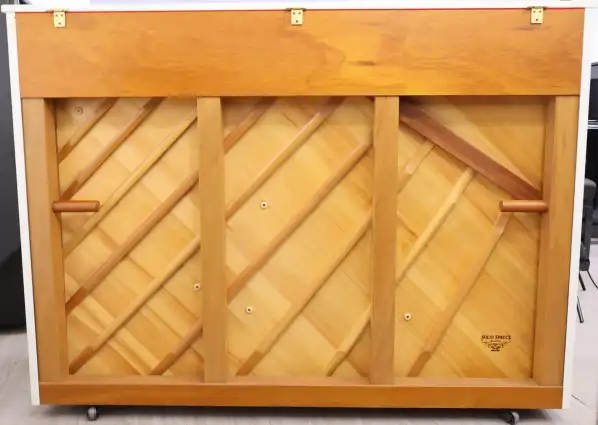
Here you can see an overview of an upright piano’s soundboard.
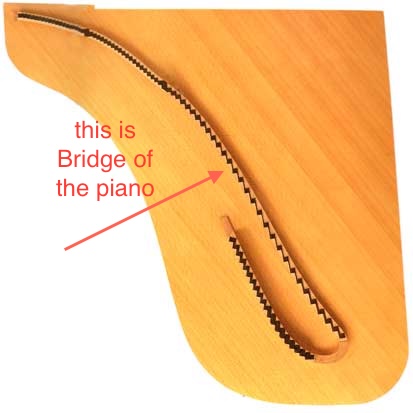
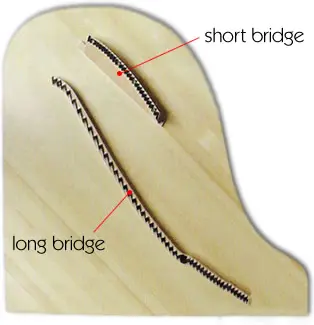
here you can see a Grand piano Soundboard front side ( Bridge also pouinted )
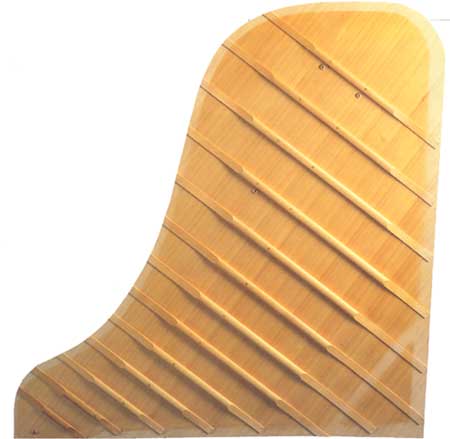
lets see back of the Soundboard
The Anatomy and the Climate Threat:
It is a common misconception that the soundboard is a single, solid sheet of wood. In reality, master piano builders craft soundboards from precisely cut strips of resonant wood—typically premium spruce—that are seamlessly bonded together with high-strength adhesives during the manufacturing process. Because wood is an organic, breathing material, it is highly susceptible to its environment. This is especially true in the UAE. The constant transition between the dry, intense desert heat outside and the heavy, continuous air conditioning inside creates climatic extremes that pose a volatile environment for acoustic instruments. Over time, these fluctuations in humidity cause the wood to expand and contract beyond its elastic limit. In lesser-quality pianos, or those not properly acclimated, this stress causes the glued joints to open, leading to severe soundboard cracking or separation in the wood, often manifesting as compression ridges across the surface.
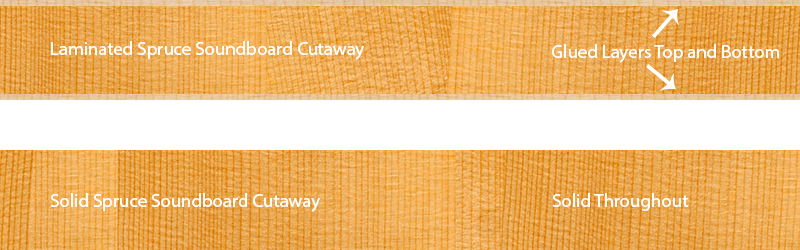
In this image, you can see the individual wooden planks used to create a soundboard. These pieces are glued together side-by-side to construct the final board.
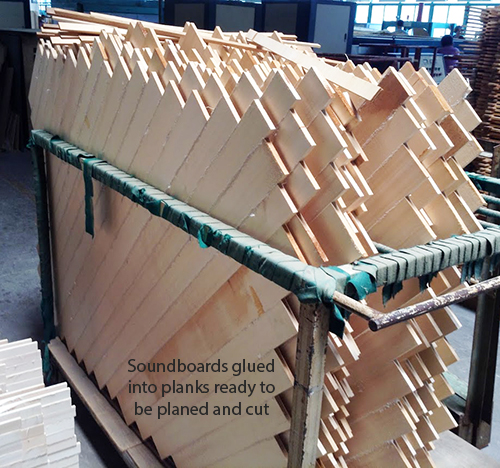
Sample of the Soundboard Wood
How to Inspect the Soundboard Yourself:
You do not always need a qualified technician by your side to spot a critical failure. When shopping for a used piano in Dubai, take control of the inspection with this simple step: walk to the vertical piano back of the upright piano and look closely at the wood. Examine the entire surface.
- Check for cracks, separations, or warping.
- Minor hairline cracks can be okay, but large ones are risky.
- If you see visible, gaping cracks, splits, or separations along the grain, it is an immediate warning sign.
in below here i will share with you 5 pictures to make it easier for you to understand what is the crack on the Soundboard
in the first Picture the piano has a Small Crack
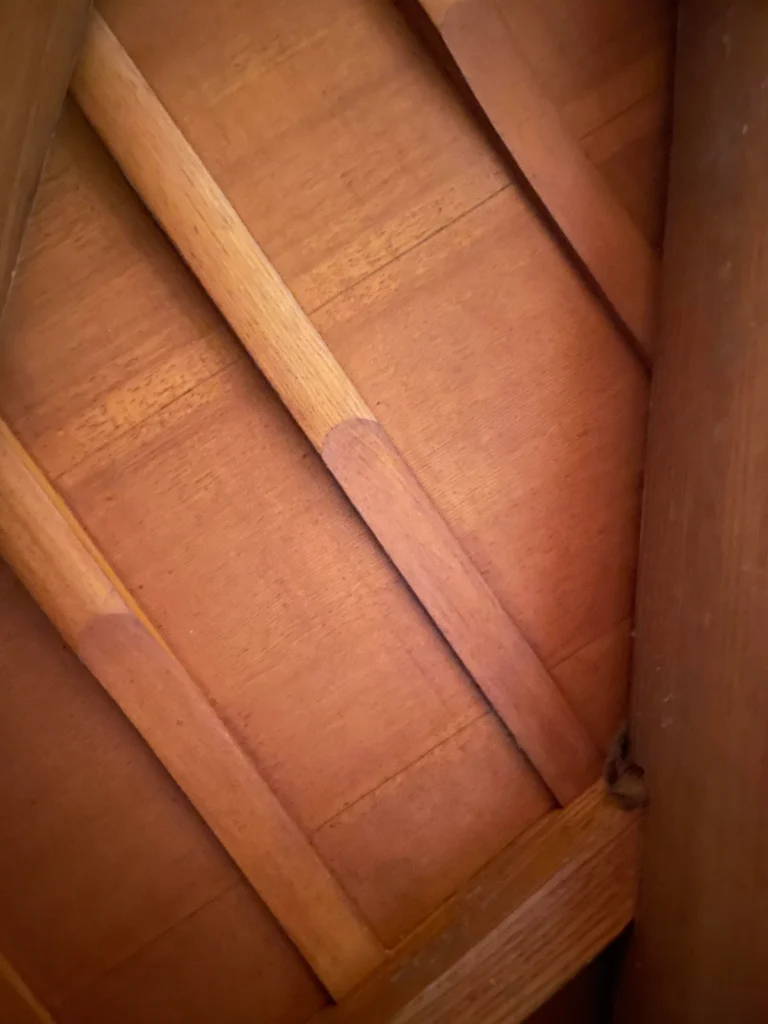
here you can see a different type of Crack on the Piano Soundboard
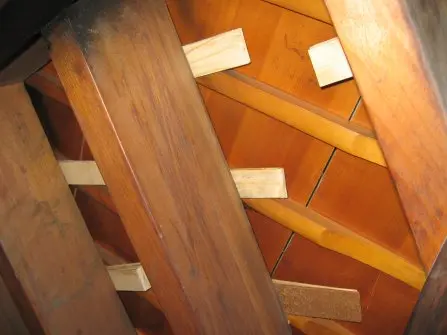
another type of the Crack on the Soundboard of a piano
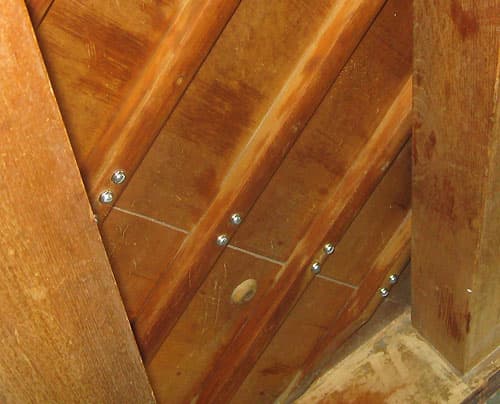
in this Image you can easily see the crack on the soundboard is behind the Strings
( Note that in most of the cases the for fixing the piano Soundboard all the strings should be open )
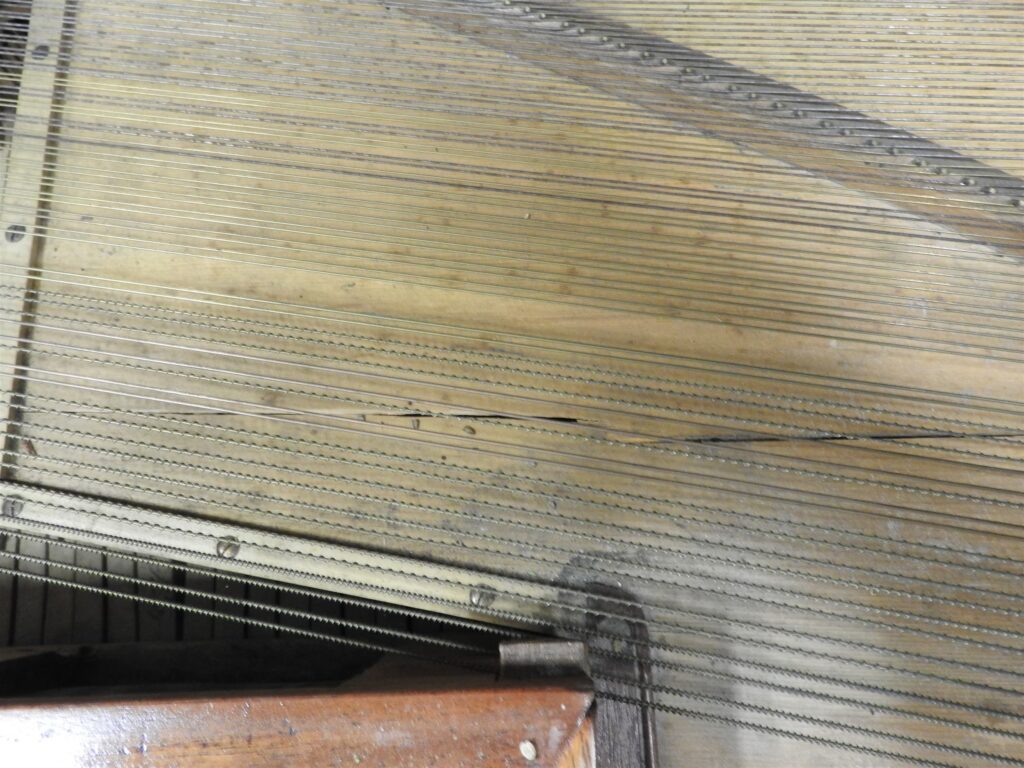
there is another Small Crack on the Soundboard
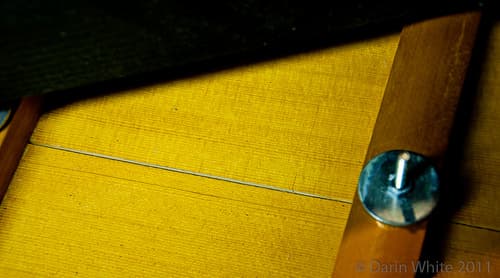
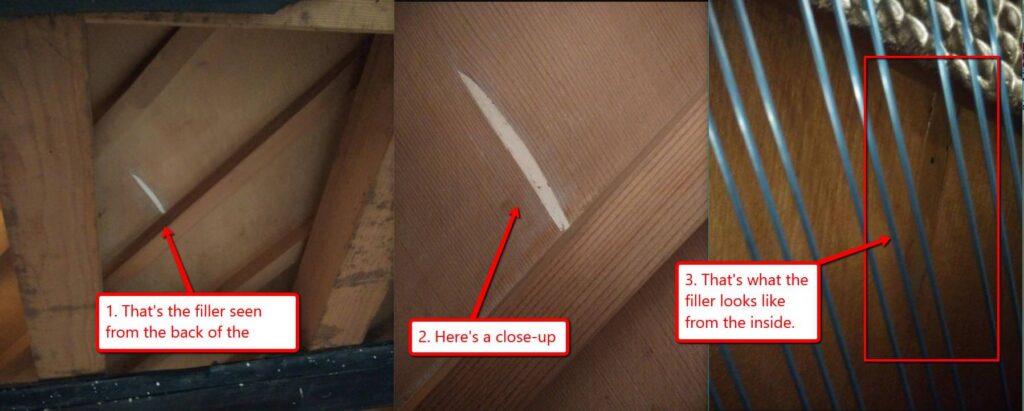
That piano will no longer project sound correctly. Furthermore, you must be incredibly wary of amateur restorations. Because the soundboard is so sensitive, properly repairing it requires factory-level engineering and deep expertise. Unfortunately, some sellers attempt to hide damage using basic wood fillers, cheap epoxies, or crude patching methods. These amateur repairs are usually obvious to the naked eye. If you notice messy glue lines, discolored patches, or unnatural textures on the wood, the instrument’s acoustic integrity has been compromised. A pristine, unblemished soundboard is your very first guarantee of a healthy, long-lasting piano.
Even though it’s fixed, you can still see it being fixed as soon as possible with your eyes.
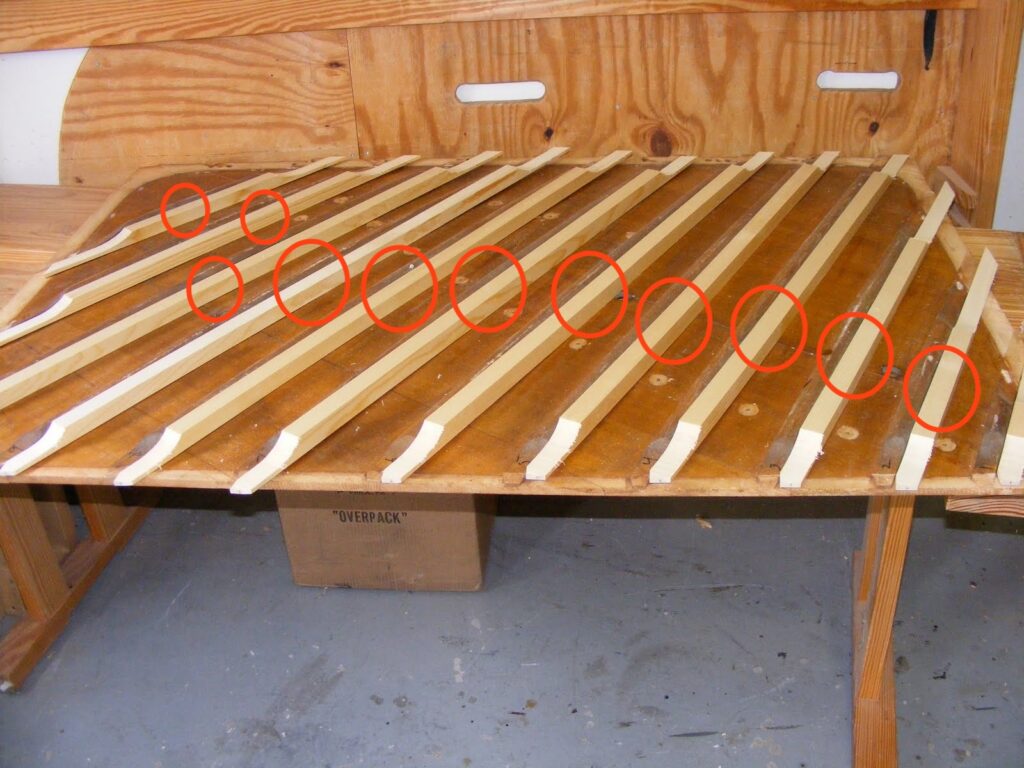
Checking the Ribs and the “Crown”: As you inspect the back of the soundboard, you will notice horizontal wooden bars crossing the vertical planks. These are called the ribs. Their primary function is to support the soundboard and maintain its soundboard crown—a very slight, intentional outward curve that pushes against the tension of the strings to maximize volume and tone. In harsh, dry climates, the glue holding the ribs to the soundboard can fail. If you gently tap along the length of the ribs and hear a distinct rattle or buzzing noise, the ribs have separated. A piano with detached ribs or a flattened crown will sound “dead” or muffled, completely lacking the vibrant tone you expect from a premium used Yamaha piano or Kawai.
here you can see the Ribs and the Crown
2. The Bridges: The Hidden Conduit
While the soundboard is the beating heart of a piano, it cannot produce a single note without its vital messenger: the bridge. The soundboard does not work in isolation; it receives its musical information from the bridge at critical bearing points. Many families and first-time buyers in Dubai completely overlook this critical component because it requires looking inside the instrument. However, knowing how to inspect the bridges is one of the most powerful secrets a buyer can possess. If a piano’s bridge is compromised, the instrument is fundamentally defective and will never serve your family’s musical needs.
here you can see the Bridge of a piano ( the red circle the Strings will tied up on the pin at the end )
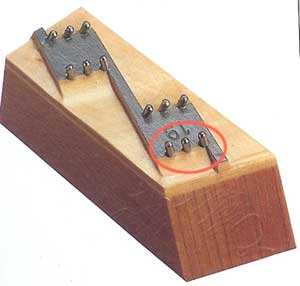
What is the Bridge and Why is it so Critical?
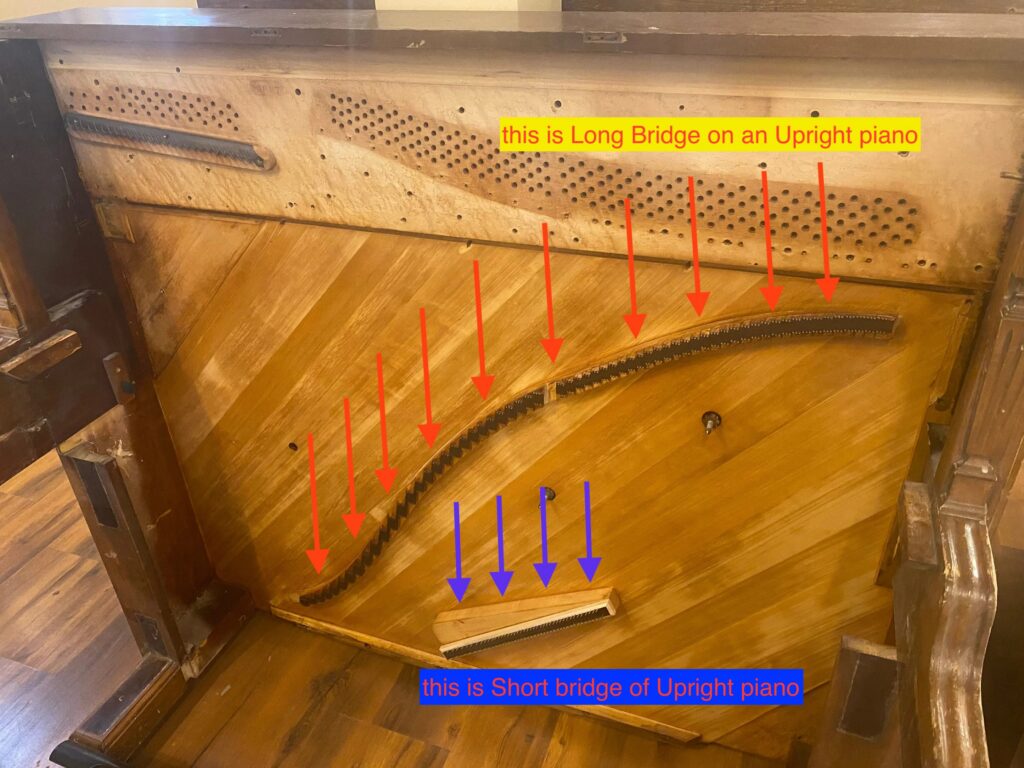
To view the lower bridges in an upright piano—such as a classic Yamaha U1 or U3—you simply need to remove the bottom wooden panel located just above the pedals. Inside, you will see the heavy strings extending downward. Before these strings anchor to the bottom of the cast-iron frame, they pass tightly over a beautifully curved piece of dense, hardwood—this is the bridge. If you open the piano and look inside, you will see the strings passing over a long, curved piece of very dense wood glued directly to the front of the soundboard. The strings are held in place on the bridge by small metal pins at the upper bearing point. The strings are locked into position on the bridge by tiny metal pins. The bridge’s job is to bear the immense downbearing pressure of the strings and transfer their vibrations directly into the soundboard.
here you can see the Bridge on a Grand piano
here is the Bridge on the upright piano ( String and Tuning pin already taken off )
The Climate Threat to Tuning Stability: Because the bridge is under such extreme pressure, it must be structurally perfect. In the harsh climate of the UAE, where intense air conditioning rapidly draws moisture out of the air, inferior or improperly seasoned wood can become dangerously brittle. Under extreme climatic stress, the dense wood of the bridge can dry out and develop hairline splits around these pins, often creating visible string dents where the wire has pressed into weakened wood. When a bridge fails, it usually develops hairline cracks right along the line of those tiny metal bridge pins. If the wood cracks, the pins become loose and shift under the tension.
The immediate, catastrophic result? The piano will never hold its tune. A cracked bridge is a catastrophic flaw. It disrupts the transfer of sound, causes irritating buzzing noises, and makes the piano virtually impossible to tune perfectly. Damaged bridges = poor sound transmission + tuning issues. A piano with a split bridge cannot maintain the international concert standard pitch of A=440 Hz. No matter how many times a tuner visits your home, the strings will simply slip back out of tune, rendering the piano musically useless.
here you can see the broken Bridge 1
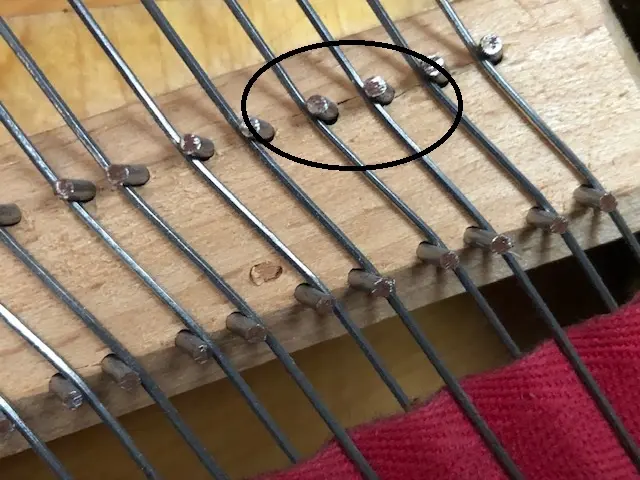
here is another picture of a Broken bridge of the piano 2
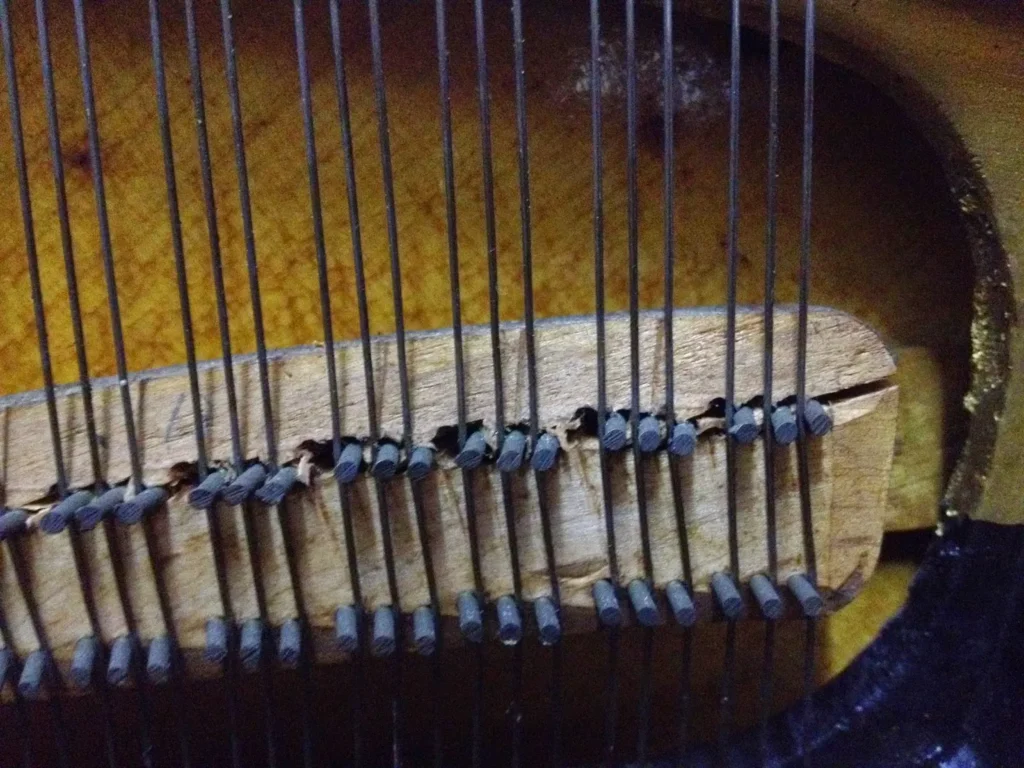
lets see the third picture of an example Piano Bridge broken 3
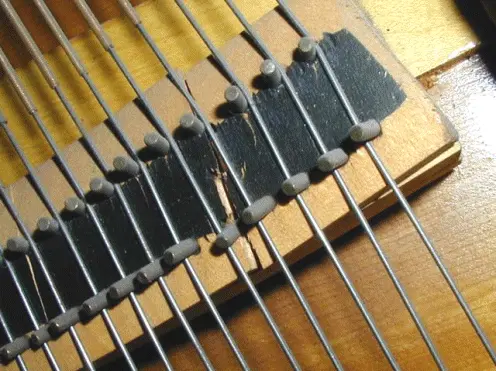
finally another view of a piano Bridge broken
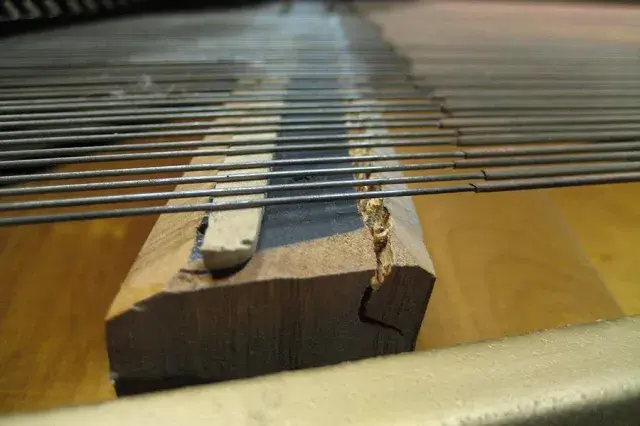
you can check if the piano bridge is Broken, how?
The 60-Second Buyer’s Inspection: You do not need to be a technician to spot a failing bridge. When viewing a pre-owned piano, ask to remove the bottom panel. Take out your smartphone flashlight and look closely at the lower bridges:
- Check the Glue Joint: Ensure the base of the wooden bridge is perfectly flush and tightly glued to the soundboard behind it. There should be no gaps, lifting, or separation.
- Inspect the Pins: Look closely at the small metal pins holding the strings on the bridge. Check if bridge pins are tight.
- Hunt for Hairline Cracks: Look for cracks where the strings sit. Look for any thin, dark lines running between the pins in the wood. Even the smallest crack is a massive red flag.
When examining the acoustic health of the instrument, a flawless bridge is just as vital as a flawless soundboard.
The Premium Japanese Advantage:
This exact structural vulnerability is why I strongly advocate for premium Japanese domestic pianos over cheaper, lesser-known alternatives in the Middle East. Master craftsmen at Yamaha and Kawai construct their bridges from meticulously seasoned, highly dense maple specifically chosen to withstand immense tension and resist splitting, even in fluctuating humidity. When you purchase a properly restored, climate-acclimated used Yamaha piano, you are investing in a bridge and soundboard system engineered to last a lifetime, ensuring your piano sounds as flawless on day one as it will a decade from now.
3. The Pinblock: The Invisible Anchor
We have explored the components you can see—the soundboard and the bridges. But what about the crucial elements hidden deep within the piano’s architecture? The greatest frustration a family can face after purchasing a used piano is discovering that the instrument simply will not stay in tune. You hire a professional tuner, the piano sounds beautiful for a week, and then it painfully drifts back out of tune. This tragic scenario is almost always caused by the failure of a completely hidden component: the pinblock.
the picture of the Grand piano pinblock
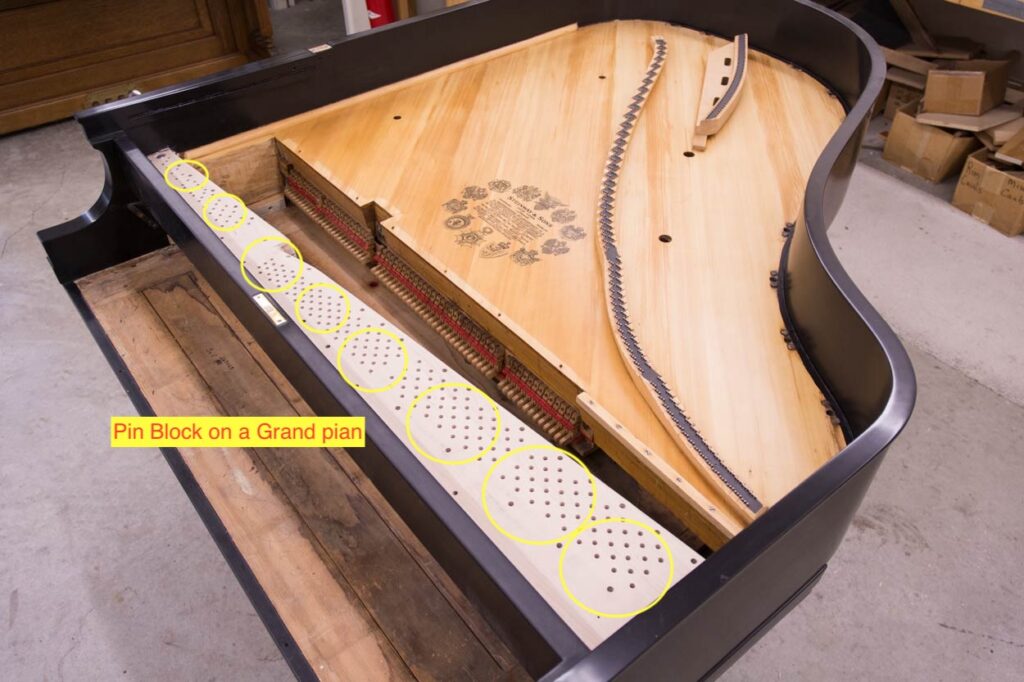
pinblock on an upright piano
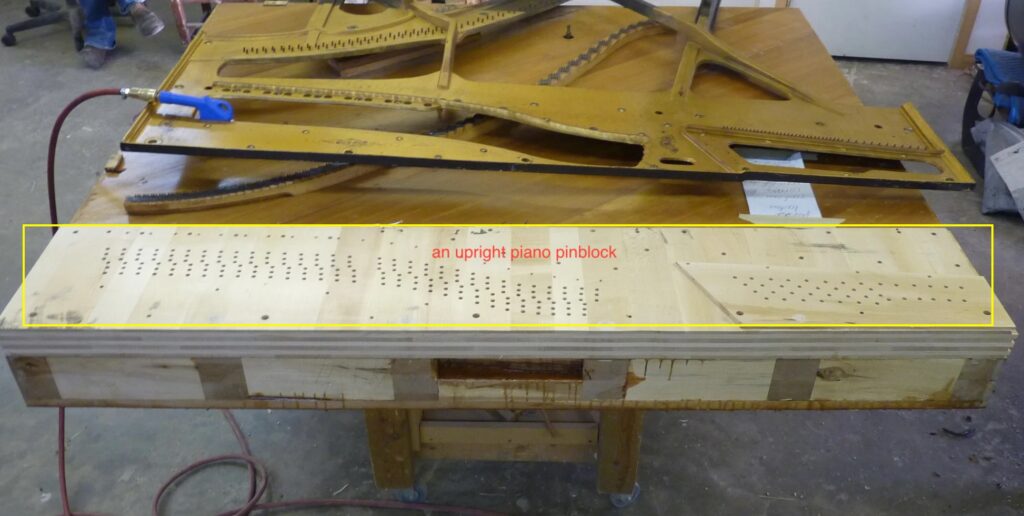
The Mechanics of Perfect Pitch:
To understand why a piano goes out of tune, you must understand how the strings are secured. At the top of an upright piano (or the front of a grand), the end of each steel string is threaded through a small hole in a thick steel peg called a tuning pin. These pins pass through the golden cast-iron plate and are driven deeply into the pinblock—a massively thick, multi-laminated plank of exceptionally hard wood, typically rock maple. As I have mentioned previously, a healthy piano must be tuned to the international concert standard of A=440 Hz. Achieving this pitch requires pulling the strings under an astonishing amount of tension—often totaling over 18 tons across the entire instrument! The pinblock’s sole responsibility is to grip those steel pins with enough microscopic friction to hold that immense tension indefinitely, maintaining the wood’s elastic limit.
here you can see some broken Binblock
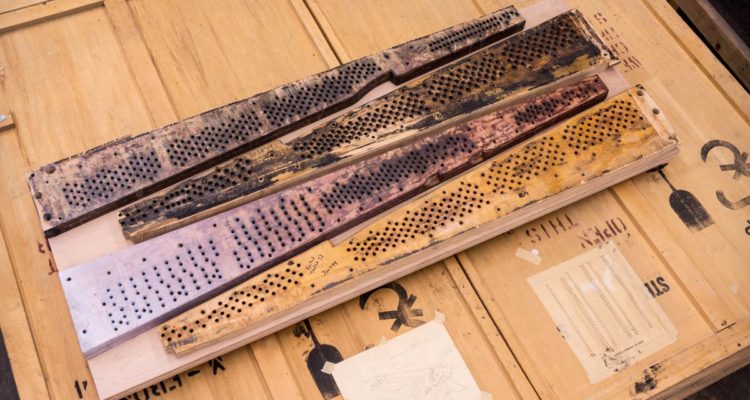
The Hidden Threat to Used Pianos: When a pinblock is defective, worn out from decades of use, or dried out due to the harsh UAE climate, the wood loses its grip.
- Are the pins tight or loose?
- If tuning pins slip → piano won’t hold tuning.
- Loose pinblock = deal breaker in many cases.
The tension of the strings violently pulls the pins loose. When a pin slips even a fraction of a millimeter, the tension drops from 440 Hz down to 420 Hz or lower, and the piano instantly sounds sour and out of tune. Here is the most critical challenge for you as a buyer: You cannot visually inspect the pinblock. Because it is sandwiched behind the massive cast-iron frame and the wooden cabinet, the pinblock is completely hidden from view. Even a seasoned technician cannot always guarantee the integrity of a pinblock just by looking at a piano; its true condition is only revealed by feeling the torque of the pins with a tuning hammer.
How to Protect Your Investment: The Lotfi Guarantee:
If you cannot see the pinblock, how can you safely buy a used piano in Dubai? The answer is simple: You must secure an ironclad warranty from a trusted merchant and seek professional evaluation. Never purchase a pre-owned piano from a private seller or an unverified dealer without a written guarantee regarding tuning stability. At Lotfi Piano Dubai,
we remove this hidden risk entirely. We understand that a piano that cannot hold its tune is merely a piece of furniture. That is why our comprehensive 5-Year Guarantee explicitly covers tuning stability and pinblock integrity. If, for any reason, your premium used Yamaha or Kawai piano fails to hold its tune to standard pitch due to a defective pinblock, we stand by our word: your instrument is eligible for a full return or exchange. When you invest in a piano, you are investing in your family’s musical journey. We provide the security and peace of mind to ensure that journey is never interrupted.
(Note to readers: To help you visualize this hidden mechanism, please see the detailed diagrams of the tuning pins and pinblock provided below.)
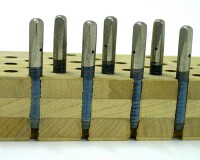
here you can see how pin going inside pinblock
second picture of Piano Pinblock
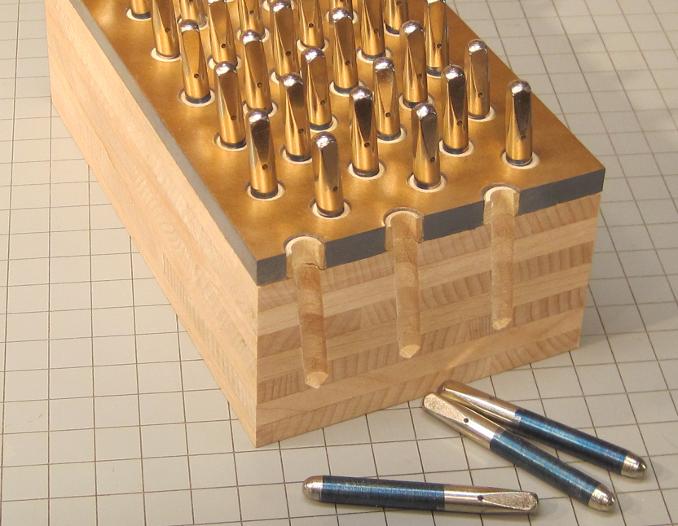
picture source
4. The Action & Mechanism: The Engine of Touch
In this guide, we are exploring the five “hearts” of the acoustic piano. A catastrophic failure in any of these five areas renders a pre-owned piano essentially unusable. Now, we arrive at the component that most frequently intimidates families and first-time buyers: The Action.
When you open the top lid of an upright piano and look inside, you are immediately confronted by a dizzying array of thousands of intricate wooden parts, felts, springs, and levers. It is a mechanical marvel. When you press a single key, this vast network instantly engages to propel a felt hammer precisely against the strings, creating the sound. Because it looks so complex, many buyers assume they have no ability to inspect it. They feel overwhelmed. But let me assure you: you do not need an engineering degree to spot a fundamentally flawed piano action. By simply looking inside, you can perform a highly effective visual audit of two vital areas.
The Main Infrastructure (Action Brackets):
Every single one of those thousands of moving parts must be anchored to a central framework. We call this the action structure. In premium pianos, the entire wooden mechanism is mounted onto heavy-duty cast metal supports known as Action Brackets, which function as a horizontal beam system. If this foundational structure is compromised, the precise alignment of the entire piano is ruined, resulting in sluggish keys, missing notes, and an unplayable instrument.
the picture of Grand piano action
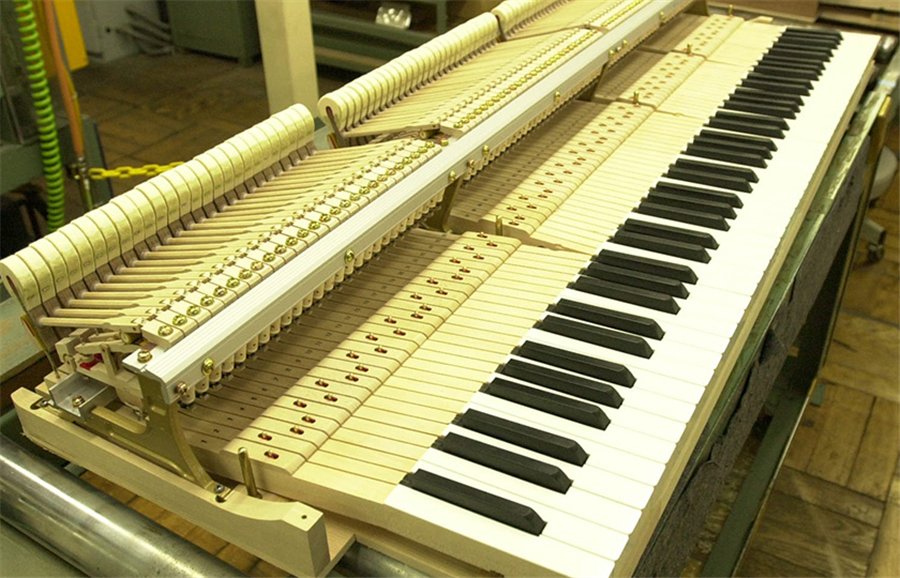
picture of upright piano action
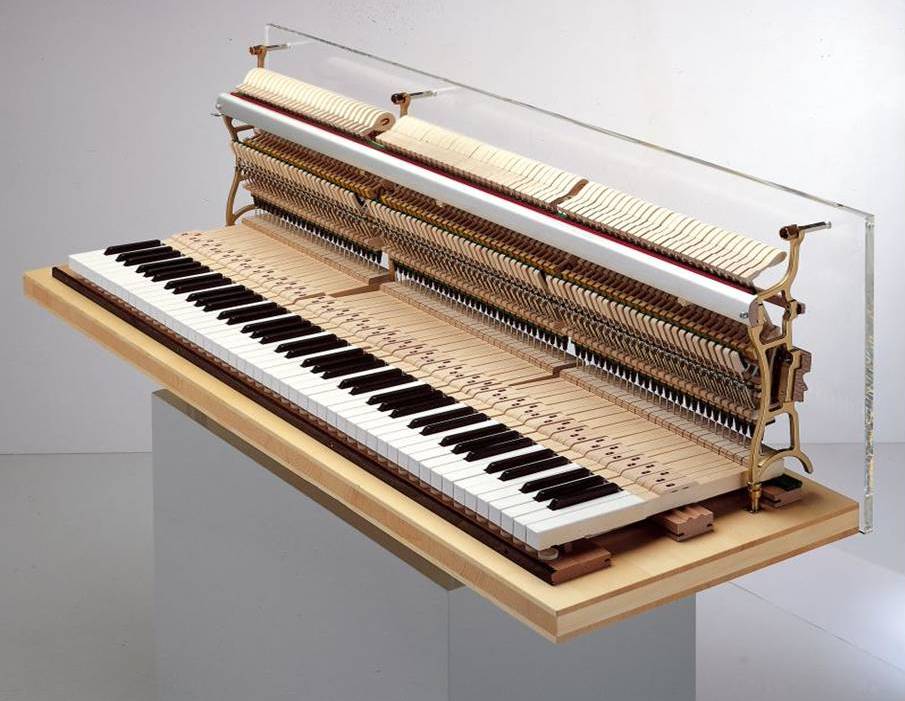
- How to inspect it:
Look past the wooden parts to the metallic pillars holding the system together. These brackets should be structurally pristine. Scan them carefully with your eyes. Are there any visible cracks in the metal? Do you see any crude, messy weld marks where someone has attempted a cheap repair? If the metal infrastructure is cracked or structurally repaired, walk away.
The Hammer Shanks (The Wooden Stems): The hammers are the teardrop-shaped felt pieces that physically strike the strings. Each hammer is attached to the main mechanism by a long, slender wooden stick called a hammer shank. Because these delicate wooden sticks absorb the force of every single note you play, they are susceptible to snapping—especially in heavily abused pianos or those exposed to the harsh, fluctuating humidity of the Middle East, which can dry out and weaken acoustic wood. Additionally, check for loose hammer heads, which indicate deteriorating glue joints.
- Check: Keys, hammers, repetition. Ensure an even touch. Check for no sticking keys. Examine hammer wear. This affects playability and control.
- How to inspect it: This is incredibly straightforward. Look at the neat, horizontal row of wooden sticks holding the hammers. They should look like a perfectly uniform, unbroken line. If you see a hammer leaning sideways, resting against its neighbor, or hanging loosely because the wooden stick is snapped in half, it is a clear indicator of neglect and internal damage.
Key Bushings and Touch Precision:
While examining the action, it is also important to understand that the smoothness and precision of each key’s movement depends on small felt rings called key bushings. These bushings line the holes in each wooden key where the metal guide pins pass through. In the UAE’s extreme climate, these felt bushings can compress, wear out, or become loose, causing keys to wobble, stick, or produce clicking noises. Worn key bushings directly compromise the evenness of touch and the pianist’s control. When you test-play a used piano, pay attention to whether each key moves smoothly and returns quietly without lateral wobbling—this indicates healthy key bushings and proper action regulation. A qualified technician may use wooden shims during regulation to adjust the lost motion compensator and ensure optimal touch response.
Pedal System Inspection: Don’t overlook the pedal system during your inspection. In grand pianos, examine the pedal lyre for stability and check that the sostenuto mechanism (middle pedal) functions correctly along with the soft pedal and damper pedal. The sostenuto mechanism is particularly important for advanced repertoire. Also check for missing casters on the piano legs, as these affect mobility and floor protection.
The Standard of Excellence at Lotfi Piano Dubai: When browsing the private used market, finding broken shanks or compromised brackets is unfortunately common. Repairing these issues requires specialized parts and the tedious labor of a master technician. When you purchase a pre-owned Japanese domestic piano from Lotfi Piano Dubai, you are guaranteed a flawless mechanism. Every used Yamaha and Kawai piano in our showroom undergoes a rigorous internal regulation process. We inspect every bracket, test every shank, and meticulously align the thousands of moving parts so that the piano responds to your family’s touch with absolute, luxurious perfection.
5. The Strings: The Secret of Originality
In our journey to understand the internal anatomy of a premium acoustic piano, we have finally reached the fifth and final “heart”: the strings. When you open the front panel of the instrument, you are greeted by a breathtaking vertical harp of steel and copper. The stringing scale ranges from thick, copper-wound strings on the left (which produce the deep bass notes) to incredibly thin, high-tension steel wires on the right in the melody range (for the sparkling treble). While a piano has well over 200 individual strings, inspecting them is not a complex task. In fact, a simple visual audit can reveal a great deal about a piano’s history and whether it meets the uncompromising standards you deserve.
here is the upright piano strings

here is the picture of Grand piano Strings

The 3-Step Visual String Inspection: You do not need specialized tools to evaluate the strings. Simply open the front panels, ensure you have good lighting, and perform this three-step visual check. For additional verification, you can perform a pluck test on individual strings to assess their tone quality and tension:
- Check for Integrity and Rust:
Slowly scan the entire length of the strings. Look for rust. Look for corrosion. Look for broken strings. They should be continuous, without any breaks, fraying, or deep, corrosive rust. Old strings = dull sound, but replaceable (not a deal breaker). However, in the humid coastal climate of the UAE, severe rust can eat into the metal, permanently deadening the tone and leading to inevitable string breakage under tension.
- The Color Consistency Test (Bass Strings): Look closely at the thick, golden-copper strings on the far left. They should all bear a consistent, uniform color and natural patina. If you notice a single string that is startlingly bright or entirely different in color from its neighbors, it means it has been replaced. While strings can occasionally break, a replaced string is a red flag. If you see this, you must always ask the dealer to explain the piano’s past trauma.
- The Coil Test at the Tuning Pin: Look closely at the thick, golden-copper strings on the far left. They should all bear a consistent, uniform color and natural patina. If you notice a single string that is startlingly bright or entirely different in color from its neighbors, it means it has been replaced. While strings can occasionally break, a replaced string is a red flag. If you see this, you must always ask the dealer to explain the piano’s past trauma. You can cross-reference the piano’s age and model using resources like the Pierce Piano Atlas to verify its manufacturing date and authenticity.
The Coil Test at the Tuning Pin: This is a master technician’s secret for spotting amateur repairs. Look at the very top of the strings, where the wire wraps around the metal tuning pins. When a premium instrument leaves the factory in Japan, the strings are coiled with flawless precision—each wrap is meticulously tight, uniform, and perfectly aligned with the rest. If you see messy, overlapping, or widely spaced coils, it is undeniable proof that the string was replaced later in its life, often by a non-factory technician.
here you can see if the strings is changed by unprofessional people !
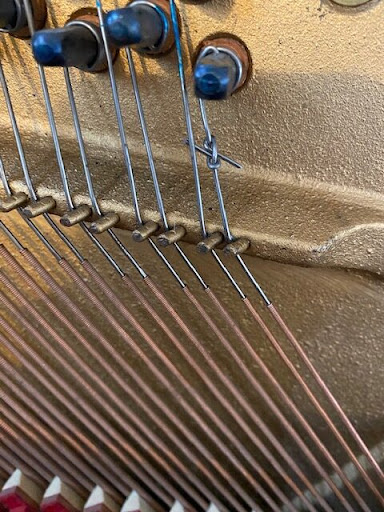
The Uncompromising Lotfi Standard: Many retailers will tell you that a replaced string is perfectly normal. However, true luxury is rooted in authenticity. At Lotfi Piano Dubai,our philosophy regarding strings is absolute. We believe the acoustic magic of a Japanese domestic model lies in its factory-original integrity. Therefore, we strictly refuse to purchase or inventory any pre-owned piano that has had its strings replaced. We will not compromise on this point, and we certainly will not pass a compromised instrument on to our clients. When you invest in a premium used Yamaha piano or Kawai from our showroom, you are guaranteed an instrument that retains 100% of its original factory stringing. We provide families across the UAE with the ultimate peace of mind: the assurance that their piano performs exactly as its master builders intended—authentic, powerful, and structurally flawless.
Final Note for Buyers: Purchasing a pre-owned instrument should never be a gamble. By understanding these structural components, you are empowered to make a secure investment. For absolute peace of mind, always source your instrument from a specialized merchant who rigorously inspects and guarantees the integrity of these vital acoustic parts.